Traveling musicians need gear that can turn spare moments into finished ideas without adding unnecessary weight. The best portable samplers combine useful sequencing, hands-on controls, reliable power options, and enough sound-shaping flexibility for practice, performance, and production.
This roundup compares 10 compact samplers and grooveboxes, ranging from ultra-portable pocket instruments to more capable standalone workstations. Use the guide below to match features, workflow, and portability to the way you make music on the move.
Best 10 Samplers for Traveling Musicians Picks for 2026
Performance Powerhouse

- Battery, USB-C, and AC power options
- 32-voice polyphony with 16 projects
- OLED editing and extensive performance effects
Best For: Live beatmakers and effects-focused producers
Idea-Capture Companion

- Built-in microphone, speaker, and sampler
- Rechargeable battery in a 16-ounce design
- Combines drums, synths, and sequencing
Best For: Mobile songwriters and all-in-one idea capture
Portable MPC Gateway

- Standalone, battery-powered MPC workflow
- Built-in mic, speaker, and microSD storage
- 16 pads, sample chopping, and 60 effect types
Best For: Beginners, finger drummers, and DAWless creators
Live Groove Specialist

- Four-hour battery for mobile sessions
- Eight sample tracks with 256-step chains
- Live FX plus slicing, reversing, looping, and resampling
Best For: Live performers and groove-focused producers
Best Lightweight Sequencer
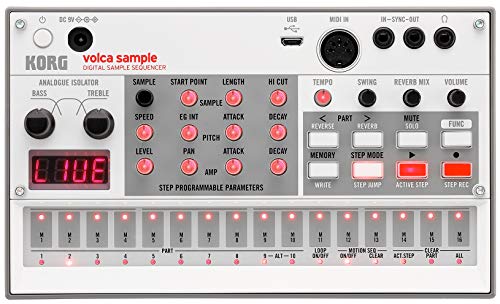
- Under-a-pound design with battery or AC power
- 16-step sequencing with pattern chaining
- Built-in speaker, reverb, filter, and USB
Best For: Mobile beat-making and compact sample sequencing
Best Pocket Creative Sampler

- Built-in mic for quick sample capture
- Chop, resample, and play samples chromatically
- Granular controls and computer software support
Best For: Portable sound design and experimental sample work
Best Pad-Based MIDI Sampler

- Eight velocity- and pressure-sensitive pads
- Loads 16-bit mono WAV files from SD cards
- USB and standard MIDI connectivity
Best For: Finger drumming and live sample triggering
Best Overall
Teenage Engineering EP-133 K.O. II
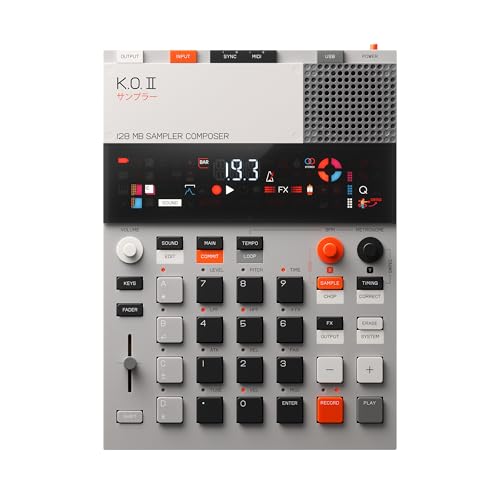
- 128MB memory and 999 sample slots
- Four-track sequencer with live effects
- Battery-powered with built-in microphone
Best For: Traveling beatmakers needing a versatile portable sampler
Best for Lo-Fi Production

- Retro 12-bit sampler mode
- Four-track sequencer with sound locking
- Battery-powered with built-in speaker
Best For: Mobile producers focused on lo-fi grooves
Most Portable
Teenage Engineering PO-33 K.O.!

- Pocket-sized and powered by two AAA batteries
- Built-in microphone with 40-second memory
- Melodic, drum, sequencing, and effects modes
Best For: Travelers who need an ultra-compact idea sketchpad
Performance Powerhouse – Roland SP-404MKII
For traveling musicians who want a performance-focused sampler, the Roland SP-404MKII combines fast beatmaking, extensive effects, and flexible power options in a compact design. Its battery compatibility and USB-C connectivity make it practical for creating away from a studio.
Best For: Live beatmakers and experienced producers who prioritize performance effects, rapid sampling, and deep sample editing.
Pros:
- Supports six AA batteries, USB-C mobile power, or an AC adapter.
- Offers 32-voice polyphony, 160 samples per project, and 16 internal projects.
- Includes OLED waveform editing, auto-chop, BPM detection, resampling, and extensive effects.
Cons:
- Its broad feature set may take time for beginners to master.
- The supplied details list a 4.6-pound item weight, making it less lightweight than some travel-focused options.
The SP-404MKII is a strong choice when portability needs to coexist with serious live manipulation and sound design. Choose it if effects and hands-on performance matter more than having a built-in speaker or microphone.
Idea-Capture Companion – Yamaha SEQTRAK
The Yamaha SEQTRAK is designed for musicians who want to capture ideas while traveling. It combines drums, synths, sound design, sequencing, onboard sampling, a microphone, a speaker, and a rechargeable battery in a compact 16-ounce unit.
Best For: Songwriters and mobile creators who want an all-in-one sketchpad for recording and arranging ideas anywhere.
Pros:
- Built-in microphone and speaker support spontaneous creation without extra gear.
- Rechargeable battery and lightweight design suit travel.
- Combines sequencing, drums, synths, sound design, and onboard sampling.
Cons:
- The supplied notes do not specify internal storage capacity or detailed sample-editing functions.
- Its compact interface may be less suited to users seeking extensive hands-on sample manipulation.
SEQTRAK stands out among samplers for traveling musicians who value immediacy and portability. It is particularly appealing for capturing rough musical concepts, though dedicated beatmakers may want more detailed sampling controls.
Portable MPC Gateway – Akai MPC Sample
The Akai Professional MPC Sample brings a familiar MPC workflow to a compact, battery-powered sampler. With a built-in speaker, microphone, rechargeable battery, microSD storage, and standalone operation, it is well suited to traveling musicians who want to record and shape samples without a computer.
Best For: Beginners, finger drummers, DAWless creators, and MPC users seeking a portable sampling and sequencing setup.
Pros:
- Standalone operation includes a microphone, speaker, rechargeable battery, and microSD storage.
- Provides 16 responsive pads, a 2.4-inch color display, and Instant Sample Chop Mode.
- Offers four FX processors, 60 effect types, internal resampling, and USB-C audio/MIDI.
Cons:
- A MIDI DIN adapter is required for traditional MIDI connections and is not included.
- The supplied notes do not identify the battery runtime.
This is a versatile travel sampler for musicians who want a straightforward path from recording to finished grooves. Its combination of MPC-style controls, onboard effects, and standalone hardware makes it accessible without giving up creative depth.
Live Groove Specialist – Novation Circuit Rhythm
The Novation Circuit Rhythm is a practical choice for traveling musicians who want to turn recordings from a phone, turntable, or synth into playable beats. Its eight sample tracks, hands-on sequencer, performance effects, and stated four-hour battery life support both mobile production and live sets.
Best For: Live performers and groove-focused producers who want flexible sample playback, sequencing, and resampling.
Pros:
- Records directly from external sources and supports slicing, reversing, looping, and resampling.
- Provides eight sample tracks with chainable patterns up to 256 steps per track.
- Includes performance effects such as lo-fi tape, beat repeat, reverb, delay, and sidechain.
Cons:
- The supplied details do not mention a built-in speaker or microphone.
- Its workflow is centered on eight sample tracks rather than the broader synthesis features of an all-in-one workstation.
Circuit Rhythm is especially compelling when live sequencing and sample manipulation are central to your setup. Its four-hour battery specification and approachable grid workflow make it a strong travel companion for beat-driven performances.
Best Lightweight Sequencer – Korg Volca Sample 2
Korg Volca Sample 2 Digital Sample Sequencer Drum Machine w/Pattern Chain Mode and 16-step Sequencer
Check Price On AmazonThe Korg Volca Sample 2 is a compact choice for traveling musicians who want sample-based beats, hands-on sequencing, and standalone operation. It weighs under a pound, includes a speaker and headphone output, and can run on six AA batteries or an AC adapter.
Best For: Portable beat-making, pattern chaining, and genres such as future bass, trap, and lo-fi hip-hop.
Pros:
- 16-step sequencer includes pattern chain mode and start delay.
- Eight-voice polyphony, expanded memory, digital reverb, and a double filter support detailed arrangements.
- USB connectivity and dedicated Librarian software simplify sample management with a computer.
- Integrated speaker, headphone output, and battery operation support mobile use.
Cons:
- Sample management relies on a computer and Librarian software for the most convenient workflow.
- Its compact 16-step design may be limiting for musicians seeking more extensive sequencing controls.
For travelers who prioritize low weight and immediate beat programming, the Volca Sample 2 offers a practical balance of portability, sequencing features, and flexible power.
Best Pocket Creative Sampler – Roland AIRA Compact P-6
The Roland AIRA Compact P-6 is designed for traveling musicians who want a small sampler with substantial sound-design depth. Its built-in microphone supports quick field sampling, while chopping, resampling, chromatic playback, and granular controls encourage experimentation away from the studio.
Best For: Mobile sound design, field sampling, custom loops, and granular sample manipulation.
Pros:
- Built-in microphone captures samples without requiring external equipment.
- Chop, step-sampling, resampling, and chromatic polyphonic playback provide versatile sample workflows.
- Dedicated filters and envelopes allow hands-on shaping of individual samples.
- P-6 Sample Tool software supports editing and importing or exporting sounds on macOS and Windows.
Cons:
- Advanced granular parameters may require more learning than a straightforward sample player.
- Computer software integration requires a compatible macOS or Windows computer for editing and transfers.
The P-6 stands out among samplers for traveling musicians who want creative flexibility in a pocket-size format, especially when capturing and transforming sounds is more important than simple playback.
Best Pad-Based MIDI Sampler – Akai Professional MPX8
The Akai Professional MPX8 is a practical option for traveling musicians who prefer triggering samples from responsive pads. It loads 16-bit mono WAV files from an SD or SDHC card, connects to MIDI hardware or a laptop, and provides balanced outputs plus a headphone connection for live or studio setups.
Best For: Finger drumming, live sample triggering, and controlling software or external MIDI equipment.
Pros:
- Eight velocity- and pressure-sensitive backlit pads support expressive triggering.
- SD or SDHC card playback allows sample use without depending entirely on a computer.
- USB MIDI and standard MIDI input and output connect to laptops and external gear.
- Balanced outputs, headphone output, and sample-kit editing software add setup flexibility.
Cons:
- It supports 16-bit mono WAV samples rather than a broad range of sample formats.
- The unit has eight pads and is primarily a controller and sample pad, not a full sequencing workstation.
- Its model year is 2013, so its feature set is less recent than newer compact samplers.
Choose the MPX8 if your travel setup centers on reliable pad performance, removable sample storage, and MIDI control rather than extensive onboard sound design.
Best Overall – Teenage Engineering EP-133 K.O. II
For musicians looking for samplers for traveling musicians, the EP-133 K.O. II combines a compact design with substantially more memory, live-oriented effects, and a capable sequencer. Its built-in microphone, speaker, battery power, and USB-C connectivity make it practical for capturing and developing ideas away from the studio.
Best For: Traveling beatmakers who want a portable sampler that can grow from quick sketches into arranged tracks.
Pros:
- 128MB memory, 999 sample slots, and built-in microphone for flexible sampling.
- Four-track sequencer with pattern variation, song mode, and real-time performance controls.
- Battery-powered operation, built-in speaker, stereo effects, and MIDI/sync connections.
Cons:
- At 10.24 inches square and 0.73 kg, it is less pocketable than a micro sampler.
- Its broad feature set may take longer to learn than a simpler travel device.
The EP-133 K.O. II is the strongest all-around choice when portability matters but you still want room for detailed sequencing, resampling, and live manipulation.
Best for Lo-Fi Production – Sonicware Liven Lofi-12
The Sonicware Liven Lofi-12 is a focused option among samplers for traveling musicians, built around retro 12-bit sampling and hands-on groovebox control. Its four-track sequencer, track effects, master effects, battery power, and built-in speaker support mobile beatmaking without requiring a full studio setup.
Best For: Producers who want a dedicated lo-fi workflow with chromatic sample playback and tactile sequencing.
Pros:
- 12-bit sampler mode delivers a deliberately retro sound profile.
- Four-track sequencer includes parameter and sound locking for varied patterns.
- Battery-powered design, built-in speaker, and multiple track/master effects suit portable use.
Cons:
- Its lo-fi-focused character is less suited to musicians seeking a clean, modern sampler sound.
- The 790 g weight and larger footprint are less convenient than a pocket-sized unit.
Choose the Lofi-12 when its vintage sampling character is central to your music. It offers a more dedicated groovebox experience than a basic sketching sampler, while remaining usable on the move.
Most Portable – Teenage Engineering PO-33 K.O.!
For musicians prioritizing minimal size, the PO-33 K.O.! is one of the simplest samplers for traveling musicians. This pocket-sized unit records through its built-in microphone or 3.5 mm input, then lets you sequence melodic and drum parts with onboard effects using two AAA batteries.
Best For: Musicians who want an ultra-portable sketchpad for short samples, beats, and melodic ideas.
Pros:
- Pocket-sized and battery-powered, with a built-in microphone and speaker.
- Supports chromatic melodic sampling, drum sequencing, and 16 onboard effects.
- Includes 8 melodic sample slots, 8 drum slots, and 40 seconds of sample memory.
Cons:
- Its 40-second sample memory is much more limited than larger portable samplers.
- The compact interface and small storage capacity are better for sketches than complex arrangements.
The PO-33 K.O.! is the clear choice for maximum portability and fast idea capture. Its limitations are real, but they also keep the workflow immediate and travel-friendly.
How We Picked the Best Samplers for Traveling Musicians
We focused on instruments that can operate as genuinely portable music-making tools rather than desktop accessories. The selection considers overall size, built-in sampling and sequencing, onboard sound-shaping tools, control layout, connectivity, power flexibility, and how quickly each device can turn an idea into a usable pattern.
Because traveling musicians have different workflows, the list includes several categories: compact grooveboxes, dedicated samplers, sample pads, lo-fi performance instruments, and pocket-sized beat makers. A larger unit may provide deeper control, while a smaller model can be easier to carry and use spontaneously.
Quick Comparison
| Best For | Look For |
|---|---|
| Complete mobile production | Standalone sequencing, sampling, effects, and multiple tracks |
| Live beat performance | Responsive pads, pattern switching, effects, and dependable timing |
| Fast idea capture | Built-in microphone, speakers, simple sampling, and quick startup |
| Minimal travel setups | Pocket-friendly dimensions, battery operation, and lightweight construction |
| Hands-on sound design | Dedicated controls for pitch, filtering, envelopes, and effects |
Key Buying Factors for Samplers for Traveling Musicians
Portability and Power
Check both physical size and how the sampler is powered. Battery operation is useful for transit, hotel rooms, and outdoor sessions, while USB power can simplify a laptop-based setup. Also consider whether the controls are large enough to use comfortably without making the device too bulky.
Sampling Workflow
Look at how samples are recorded, trimmed, assigned, and recalled. A built-in microphone makes spontaneous recording easier, while USB or computer transfer is better for organizing a prepared library. Storage capacity and sample-management software can matter as much as the sampling engine itself.
Sequencing and Performance Controls
Pattern length, track count, step sequencing, pattern chaining, velocity-sensitive pads, and live effects all influence how useful a device is beyond basic sample playback. Choose the workflow that matches your habits: grid-based sequencing favors precise arrangement, while pad-oriented controls are often better for improvisation.
Connectivity
Review the available audio outputs, MIDI connections, USB features, and synchronization options. MIDI and clock support help integrate a sampler with a keyboard, drum machine, or laptop. Headphone output is especially important for quiet work while traveling.
Sound and Build Priorities
Some instruments emphasize clean modern sampling, while others deliberately offer reduced bit depth, filtering, or lo-fi character. Decide whether you want accurate playback, distinctive coloration, or both. A sturdy enclosure and protected controls are also valuable when gear will be packed frequently.
Who Should Buy Which Samplers for Traveling Musicians?
Choose a full-featured groovebox if you want one device to handle sampling, sequencing, effects, and live arrangement. A compact creative sampler is a better fit for musicians who prioritize portability but still want hands-on performance control. Dedicated sample pads suit performers who mainly trigger one-shots and backing parts, while pocket samplers are ideal for quick sketches, travel practice, and highly minimal setups.
For retro or deliberately imperfect textures, consider a lo-fi sampler with reduced-resolution processing and a focused sequencer. If you are new to portable sampling, prioritize an intuitive interface and fast sample transfer over the longest feature list. The best choice is the one you can carry easily, power reliably, and use often enough to turn passing ideas into complete musical parts.