Choosing among clarinets for children depends on whether your child is ready to learn real fingerings and embouchure or simply wants an engaging musical toy. The products in this roundup span colorful play instruments, beginner accessories, learning resources, and full-size student clarinets.
Use the guide below to match the instrument with your child’s age, goals, supervision needs, and willingness to practice. A realistic fit can make early music experiences more enjoyable and help prevent frustration.
Best 10 Clarinets for Children Picks for 2026
Best Beginner Clarinet for Small Hands
Nuvo Dood Plastic Beginner Clarinet

- Recorder-style fingering for young learners
- Waterproof, washable ABS-resin body
- Includes case, reeds, ligature, and fingering chart
Best For: Ages 4+ and pre-band music programs
Best Musical Play Set for Preschoolers
3-in-1 Kids Musical Instruments

- Includes trumpet, harmonica, and recorder
- Designed for ages 3 and up
- Comes with storage and cleaning accessories
Best For: Early musical exploration and pretend band play
Best Full-Size Student Option
Bb Clarinet 17 Keys for Beginners

- Standard 17-key Bb clarinet layout
- Durable, wipe-clean ABS body
- Includes case, two barrels, reeds, and accessories
Best For: Older children and student beginners
Best Pretend-Play Clarinet
Bontempi Toy Clarinet for Kids

- Eight color-coded keys and notes
- Song prompts printed on the box
- Lightweight plastic design needs no batteries
Best For: Toddlers and young children’s imaginative play
Top Student Clarinet
Rhythm Bb Clarinet Starter Set

- Bb clarinet with 17 nickel keys
- Includes case, stand, 10 reeds, and cleaning kit
- Suitable for beginners and student players
Best For: Beginning students needing a complete clarinet package
Best Learning Resource
Beginning Clarinet Book for Kids

- Large notation and kid-friendly instructions
- Includes fingering charts and simplified arrangements
- Comes with online audio and video resources
Best For: Elementary and middle school beginners learning clarinet
Best Pretend-Play Set
Lewtemi Kids Musical Instrument Trio

- Includes plastic saxophone, clarinet, and trumpet
- Color-coded keys encourage early exploration
- Recommended for supervised play from ages 3 to 12
Best For: Young children discovering music through pretend play
Best Pitch-Ready Pick

- 13 standard keys for intuitive play
- BPA-free plastic with silver finish
- Ready to play and includes a one-year warranty
Best For: Young beginners wanting a single toy clarinet
Best Color-Coded Set
Amylove Trumpet and Clarinet Duo

- Includes a toy trumpet and clarinet
- Eight colored keys support simple song play
- Lightweight 16.5-inch beginner design
Best For: Children 6 and up who enjoy variety and visual learning
Best Multi-Instrument Gift
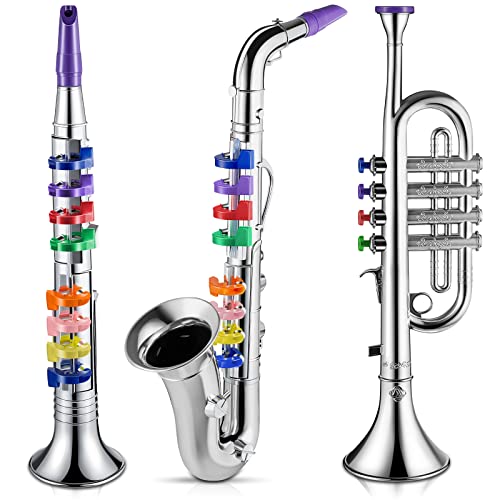
- Includes saxophone, clarinet, and trumpet
- Color-coded keys support playful exploration
- Designed for gifts, parties, and pretend performances
Best For: Children 6 and up exploring multiple toy instruments
Best Beginner Clarinet for Small Hands – Nuvo Dood Plastic Beginner Clarinet
For families comparing clarinets for children, the Nuvo Dood is a lightweight, durable option designed for young learners ages 4 and up. Its recorder-style fingering, single-reed setup, and washable ABS-resin construction make it approachable for early practice, classroom use, and group music activities.
Best For: Young beginners transitioning from recorder-style instruments toward clarinet technique.
Pros:
- Recorder-style fingering is suited to small hands.
- Lightweight, waterproof construction is easy to clean and maintain.
- Plays a full chromatic scale over one octave and includes a case, two synthetic reeds, ligature, and fingering chart.
Cons:
- Its mellow, clarinet-like sound is not the same as a standard concert clarinet.
- The instrument is tuned in concert C rather than standard Bb clarinet tuning.
The Dood is a practical bridge between recorder study and traditional clarinet playing. Its simple design and maintenance-friendly materials are especially useful for early learners and shared music settings.
Best Musical Play Set for Preschoolers – 3-in-1 Kids Musical Instruments
Although this set is not a traditional clarinet, it can be a useful entry point for families exploring clarinets for children alongside other beginner instruments. The package combines a breath-activated toy trumpet, 16-hole harmonica, and three-piece recorder for hands-on musical play from age 3.
Best For: Preschoolers who want to experiment with several wind instruments through play.
Pros:
- Offers three different instruments and playing styles in one set.
- Includes a storage bag, recorder cleaning rod, strap, screwdriver, and fingering chart.
- The toy trumpet adds lights, songs, rhythms, volume levels, and scale buttons.
Cons:
- It does not include a clarinet.
- The trumpet requires three AAA batteries, which are not included.
- The electronic trumpet should not be immersed in water.
This set is best viewed as an exploratory music toy rather than a clarinet-training instrument. It gives young children varied opportunities to practice breath control, fingering, and musical creativity before committing to a dedicated instrument.
Best Full-Size Student Option – Bb Clarinet 17 Keys for Beginners
For older children and students ready for a conventional instrument, this pink Bb clarinet provides the familiar 17-key layout used by beginner and school musicians. Its ABS body, nickel-plated keys, two barrels, and included accessories give new players a practical starting package.
Best For: Student beginners who are ready to learn on a standard Bb clarinet design.
Pros:
- 17 nickel-plated keys and Bb tuning provide a conventional student setup.
- ABS construction is durable and can be wiped clean after use.
- Includes a case with strap, two barrels, mouthpiece accessories, cloth, gloves, and reeds.
Cons:
- At 1.71 kg, it is substantially heavier than child-focused plastic starter instruments.
- The supplied warranty is limited to 60 days.
- Assembly is required before playing.
This model makes more sense for a child who has the size and readiness for a standard clarinet than for a very young beginner. The included case and accessories support practice and portability, while the ABS body simplifies basic upkeep.
Best Pretend-Play Clarinet – Bontempi Toy Clarinet for Kids
For families seeking clarinets for children mainly for imaginative play, the Bontempi toy clarinet offers a simple, low-commitment introduction to musical pretend play. It has eight color-coded keys, a shiny silver plastic finish, and printed songs on the box for children ages 18 months to 7 years.
Best For: Toddlers and young children interested in pretend marching-band or home-orchestra play.
Pros:
- Eight color-coded keys correspond to eight different notes.
- Printed songs on the box encourage interactive play.
- Lightweight plastic design requires no batteries.
Cons:
- It is a toy clarinet, not a conventional learning clarinet.
- The simple key system is not described as standard clarinet fingering.
- It is intended for indoor play rather than formal instrument study.
The Bontempi is a sensible choice when the goal is musical curiosity and imaginative play rather than structured clarinet instruction. Its color-coded keys and song prompts can help a child engage with basic notes in an accessible way.
Top Student Clarinet – Rhythm Bb Clarinet Starter Set
For shoppers comparing clarinets for children, this Rhythm Bb clarinet set offers a full-size-style starter package with a case, stand, reeds, and cleaning supplies. Its black-and-silver finish and factory tone adjustment make it a practical option for beginners, students, or gift buyers.
Best For: Beginning students who need an instrument and essential accessories in one package.
Pros:
- Includes a clarinet case, stand, 10 reeds, and cleaning and care kit.
- Bb instrument with 17 nickel keys.
- Designed for students, beginners, professional players, and gift recipients.
- Factory tone adjustment and product inspection are noted by the seller.
Cons:
- At 1.71 kg, it may feel substantial for younger children.
- The supplied details do not specify a child-specific size or age range.
This is the most complete instrument-focused choice in the group, especially for a child beginning band and needing basic accessories immediately. Parents should confirm that the size and weight suit the player.
Best Learning Resource – Beginning Clarinet Book for Kids
Best Beginning Clarinet Book for Kids (Best Beginning Band Books for Kids Series)
Check Price On AmazonFor families choosing clarinets for children, a clear method book can make early practice more manageable. This kid-focused guide uses large notation, fingering diagrams, simplified arrangements, and step-by-step lessons for elementary and middle school beginners.
Best For: First-year clarinet students using band classes, private lessons, or home practice.
Pros:
- Uses extra-large notation and clear fingering charts.
- Includes step-by-step instruction, illustrations, and familiar songs.
- Offers online play-along audio, videos, and demonstrations.
- Covers reading music, rhythms, technique, theory, and ensemble playing.
Cons:
- This is an instructional book, not a clarinet or accessory kit.
- The content is presented in English.
This book is a useful companion for a young player who already has access to a clarinet. Its limited material per page and visual guidance are particularly suited to structured beginner practice.
Best Pretend-Play Set – Lewtemi Kids Musical Instrument Trio
Among clarinets for children, this Lewtemi set is best viewed as an introductory toy rather than a playable band instrument. It includes plastic saxophone, clarinet, and trumpet toys with color-coded keys, giving toddlers and young children a hands-on way to explore music and pretend performances.
Best For: Children ages 3 to 12 exploring instruments through supervised play, parties, or gifting.
Pros:
- Includes three lightweight plastic instruments: saxophone, clarinet, and trumpet.
- Color-coded keys support simple note recognition and experimentation.
- Suitable for pretend performances, themed parties, and early music exploration.
- Designed as a colorful birthday, holiday, or family activity gift.
Cons:
- The instruments do not produce precise pitch or melody.
- It is not a professional or formal clarinet-learning instrument.
- Adult supervision is recommended to help prevent accidental swallowing.
This set can spark curiosity before a child commits to formal lessons, but buyers should set expectations: it is a decorative and entertainment-focused toy, not a substitute for a student clarinet.
Best Pitch-Ready Pick – My First Silver Toy Clarinet
For families looking at clarinets for children, this 16-inch silver toy clarinet offers a straightforward introduction to playing. Its 13 standard keys, plastic BPA-free construction, and ready-to-play design make it a practical first instrument for young beginners.
Best For: Children ages 3 and up who want a single, easy-to-use toy clarinet for early music exploration.
Pros:
- Standard keys are designed to be intuitive for beginners.
- Made from BPA-free plastic resin with a shiny silver finish.
- Ready to play out of the box and includes a one-year warranty against manufacturing and material defects.
- Compact 16-inch size and lightweight 4.8-ounce design are easy for children to handle.
Cons:
- It is a toy instrument rather than a professional clarinet.
- The listed recommended age range is 24 months to 8 years, while the product title specifies ages 3 and up.
This is the strongest choice of the three for parents prioritizing a single toy clarinet with standard keys, a polished appearance, and stated pitch-focused construction. It is best viewed as an early learning tool, not a substitute for a full-size student instrument.
Best Color-Coded Set – Amylove Trumpet and Clarinet Duo
This two-piece set is a flexible option for shoppers comparing clarinets for children with broader musical-play needs. It includes a plastic trumpet and an eight-colored-key clarinet, with color-matched notes intended to help beginners follow simple songs without prior music theory.
Best For: Children ages 6 and up who will enjoy switching between two lightweight toy instruments and learning through color cues.
Pros:
- Includes both a toy trumpet and clarinet for variety and sharing.
- Color-coded keys and matching score colors provide an accessible learning approach.
- Lightweight, portable instruments measure about 16.5 inches long.
- Designed to support rhythm, melody, hand-eye coordination, independence, and confidence.
Cons:
- Adult supervision is recommended to help prevent accidental swallowing.
- The set uses plastic toy instruments and is intended for beginner play rather than advanced instruction.
The Amylove set stands out when variety and guided, color-based play matter more than a traditional single-instrument setup. It offers more activities than a standalone clarinet, though its six-and-up recommendation makes it less suitable for very young toddlers.
Best Multi-Instrument Gift – Lewtemi Kids Music Set
Families seeking clarinets for children as part of a broader pretend-play collection may prefer this three-piece Lewtemi set. It includes a toy saxophone, clarinet, and trumpet with color-coded keys for casual musical exploration, parties, and family activities.
Best For: Children ages 6 and up who want to try several toy wind instruments for entertainment, themed events, or early music discovery.
Pros:
- Three-piece set includes a saxophone, clarinet, and trumpet.
- Color-coded keys encourage experimentation without prior music theory.
- Lightweight, approximately 16-inch instruments are simple for beginners to handle.
- Suitable for gifts, pretend performances, themed parties, and family activities.
Cons:
- The supplied notes state that the instruments have no precise pitch or melody.
- It is better suited to decorative or entertainment use than professional instruction.
- Adult supervision is recommended to help prevent accidental swallowing.
Choose the Lewtemi set when breadth and playful discovery are the priorities. Its clear limitation is the lack of precise pitch or melody, so children preparing for structured clarinet lessons may need a more accurate student instrument later.
How We Picked These Clarinets for Children
We grouped the selections by their intended use rather than treating every item as a full musical instrument. The list includes toy clarinets for imaginative play, multifunction children’s instrument sets, a beginner clarinet book, and student-style Bb clarinets with standard key layouts. We considered age appropriateness, ease of handling, included accessories, portability, construction, and whether the product supports genuine beginner study.
Because product specifications can vary, check the current listing for dimensions, materials, included reeds, mouthpieces, cases, and recommended age before ordering. Toy instruments are not interchangeable with band instruments, even when they resemble them.
Quick Comparison
| Type | Best For | What to Expect |
|---|---|---|
| Toy clarinet | Early play and pretend performances | Simple construction, bright finishes, and limited musical functionality |
| Multi-instrument set | Exploring several instruments | More variety, but not necessarily a realistic clarinet experience |
| Student Bb clarinet | Lessons, school band, and structured practice | Standard-style fingering, reeds, maintenance, and a steeper learning curve |
| Clarinet method book | Guided practice | Exercises and instruction that work best with an appropriate instrument |
Key Buying Factors for Clarinets for Children
Purpose and Musical Readiness
First decide whether the goal is play or instruction. A toy can be a sensible low-cost introduction for a preschooler, while a child beginning formal lessons generally needs a properly sized student clarinet recommended by a teacher.
Size, Weight, and Ergonomics
Children must be able to support the instrument comfortably and reach the keys without excessive stretching. Ask a music teacher or shop professional about fit, especially for younger players. A difficult-to-hold clarinet can make correct posture and fingering harder.
Materials and Maintenance
Plastic student clarinets are typically easier to handle and less sensitive to knocks than wooden models. Real clarinets also require reeds, swabbing, cork care, regular cleaning, and safe storage. Confirm that essential accessories are included or budget for them separately.
Sound and Key System
For lessons or school ensembles, look for a Bb clarinet with a conventional key arrangement and compatible replacement parts. Decorative toy keys may look convincing but may not produce standard notes or support method-book exercises.
Safety and Supervision
Check age guidance and small-part warnings on toy sets. Young children should use instruments under supervision, particularly when products include detachable mouthpieces, reeds, or small accessories.
Who Should Buy Which Clarinets for Children?
- Preschool children: Choose a lightweight toy clarinet or a simple instrument set for supervised exploration.
- Children curious about several instruments: A multi-instrument kit offers variety before your family commits to lessons.
- Beginners starting formal study: Choose a genuine student Bb clarinet, ideally with advice from the child’s teacher.
- Young players who need structure: Pair a suitable clarinet with a beginner method book and a consistent practice routine.
- Families shopping for gifts: Prioritize age-appropriate construction, storage, and included accessories over appearance alone.
The best choice is the one that matches your child’s current ability and next step. If interest develops into regular practice, upgrading from a toy to a teacher-approved student clarinet is usually more useful than buying the most elaborate-looking option first.