The best multitrack recorders with external microphone input give musicians, filmmakers, podcasters, and mobile producers a practical way to capture several sources without carrying a full-sized studio setup.
These 10 options range from compact two-channel recorders to dedicated portable multitrack workstations, with differences in track count, input type, monitoring, storage, effects, and workflow.
Best 10 Multitrack Recorders with External Microphone Input Picks for 2026
Best All-Around Pick

- Four XLR/TRS inputs with phantom power
- Up to 24-bit/96kHz WAV recording
- Includes XY and MS microphone capsules
Best For: Flexible multitrack recording for music, podcasts, and video
Simple Four-Channel Option

- Four-channel recording with built-in and external mics
- Selectable 90- or 120-degree X/Y microphones
- 24-bit/96kHz Linear PCM support
Best For: Compact hybrid recording with built-in and external microphones
Best for DSLR Audio
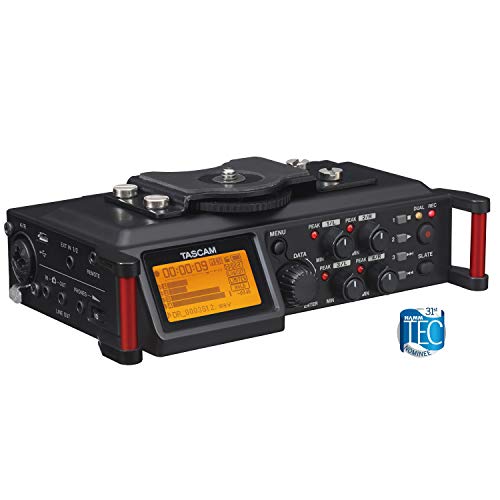
- Four balanced XLR inputs with phantom power
- Individual gain controls and 64dB preamp gain
- Dual Recording safety-copy mode
Best For: Multi-microphone production audio for DSLR and video work
Best for Mobile Music Production

- Eight-track recording with two combo inputs
- Touchscreen editing and onboard mixing
- USB-C interface with battery operation
Best For: Computer-free demos, songwriting, and mobile production
Best Pocketstudio for Simple Multitrack Ideas

- Six-track recording with CD-quality WAV audio
- Two built-in omnidirectional condenser microphones
- Battery operated with up to 9 hours of recording
Best For: Portable songwriting and quick musical sketches
Best Touchscreen Recorder with External Mic Inputs

- Eight-track recording with two XLR/TRS combo inputs
- 48V phantom power and Hi-Z input support
- Touchscreen editing, effects, loops, and USB-C interface
Best For: Computer-free recording with microphones and instruments
Best Traditional Eight-Track Pocketstudio

- Eight-track WAV recording in a portable format
- Built-in stereo microphones for quick capture
- Includes a 2GB SD card and USB cable
Best For: Battery-powered songwriting with more track capacity
Best XLR Flexibility

- Two locking XLR/TRS inputs
- 32-bit/96kHz recording
- Waveform display and 3.5mm I/O
Best For: Portable interviews, podcasts, and instrument recording
Best Layering Workflow

- Records and bounces up to four tracks
- Two XLR/TS combo inputs
- Built-in rhythms and USB interface mode
Best For: Portable songwriting and layered music production
Best Compact Stereo Option
Xvive XV1-R Portable Stereo Recorder

- 32-bit float stereo recording
- Built-in X/Y microphones up to 96kHz
- USB microphone and auto-record functions
Best For: Portable stereo capture and mobile USB recording
Best All-Around Pick – Zoom H6
The Zoom H6 is a flexible choice among multitrack recorders with external microphone input, combining four XLR/TRS inputs with interchangeable stereo microphone capsules. It records up to 24-bit/96kHz audio directly to SD cards and can also work as a multichannel USB audio interface.
Best For: Musicians, podcasters, and video creators who need several external inputs in a portable recorder.
Pros:
- Four XLR/TRS inputs with individual gain controls, pads, and phantom power.
- Records WAV or MP3 files to SD cards up to 128GB.
- Includes XY and MS microphone capsules plus USB interface functionality.
- Supports up to 24-bit/96kHz recording.
Cons:
- Requires four AA batteries for portable operation.
- The optional hot-shoe adapter is needed for direct DSLR or camcorder mounting.
The H6 stands out when you want external microphone flexibility without giving up built-in stereo recording. Its four inputs and high-resolution recording support make it a strong general-purpose option for field and project work.
Simple Four-Channel Option – Zoom H4N
The Zoom H4N is a straightforward option for buyers seeking multitrack recorders with external microphone input. Its built-in X/Y microphones can record alongside external microphones for four-channel simultaneous recording, with support for 24-bit/96kHz Linear PCM audio.
Best For: Users who want a compact recorder for combining built-in stereo sound with external microphones.
Pros:
- Supports four-channel simultaneous recording using built-in and external microphones.
- Built-in X/Y microphones offer selectable 90- or 120-degree recording angles.
- Records 24-bit/96kHz Linear PCM audio.
- USB connectivity supports use with compatible computers and mobile devices.
Cons:
- Uses two AA batteries, which may limit longer untethered sessions.
- Its listed digital recording time is 11 hours.
The H4N focuses on accessible four-channel recording rather than extensive input expansion. It is a practical fit when built-in microphones and external microphone support are both important.
Best for DSLR Audio – TASCAM DR-70D
The TASCAM DR-70D is designed for filmmakers who need multitrack recorders with external microphone input alongside a camera. It provides four balanced XLR inputs with phantom power, built-in microphones, individual gain controls, and safety-focused recording features.
Best For: DSLR shooters, documentary crews, and production teams recording multiple microphones on location.
Pros:
- Four balanced XLR microphone inputs with phantom power.
- Individual gain controls and HDDA preamps with up to 64dB of gain.
- Dual Recording mode creates a lower-level safety copy to help prevent distorted takes.
- Supports SD, SDHC, and SDXC cards up to 128GB.
Cons:
- At 1.2 pounds, it is heavier than the listed Zoom handheld recorders.
- Its 1.5-inch screen is relatively compact for setup and monitoring.
The DR-70D is especially compelling when camera-mounted production and multiple XLR microphones are central to the workflow. Its safety-copy function adds useful protection during unpredictable shoots.
Best for Mobile Music Production – Zoom R12
The Zoom R12 takes a workstation-style approach to multitrack recorders with external microphone input. It offers eight-track recording, two XLR-1/4-inch combo inputs with phantom power, touchscreen editing, onboard mixing, and operation without a computer.
Best For: Musicians and producers who want to build demos or full song projects away from a computer.
Pros:
- Provides eight-track recording with 24-bit/44.1kHz audio.
- Two combo inputs accept XLR or 1/4-inch connections and provide phantom power.
- Includes touchscreen editing, onboard mixing, effects, and track-level processing.
- Works as a USB-C audio interface and can run on AA batteries, USB-C, or the included adapter.
Cons:
- It has two combo inputs, fewer than the four-input recorders in this roundup.
- At 3.62 pounds, it is less handheld-oriented than traditional portable recorders.
The R12 is better suited to arranging, mixing, and producing than to minimalist field capture. Its larger multitrack workflow and built-in creative tools make it a strong choice for mobile song production.
Best Pocketstudio for Simple Multitrack Ideas – Tascam DP-006
The Tascam DP-006 is a compact option for musicians seeking multitrack recorders with external microphone input, while also providing two built-in omnidirectional condenser microphones for quick songwriting sessions. It records up to six tracks at CD-quality 16-bit/44.1kHz resolution and runs on four AA batteries.
Best For: Songwriters who want a lightweight, battery-operated recorder for sketching and developing ideas.
Pros:
- Supports up to six tracks with simultaneous recording on two tracks.
- Includes two built-in omnidirectional condenser microphones.
- Offers a dedicated stereo master track and WAV recording.
- Stores up to 9 hours of digital recording.
Cons:
- The supplied notes identify built-in microphones rather than specifying external microphone inputs.
- Its 2.5mm headphone jack may be less convenient for users with standard 3.5mm headphones.
The DP-006 emphasizes portability and straightforward recording rather than extensive production features. It is a practical pick for capturing musical ideas away from a computer, especially when its built-in microphones meet your needs.
Best Touchscreen Recorder with External Mic Inputs – Zoom R12 Portable Recorder
The Zoom R12 is a strong choice among multitrack recorders with external microphone input, featuring two XLR/TRS combo inputs and up to eight-track recording. Its touchscreen, onboard editing, effects, drum loops, and USB-C connectivity support a more complete computer-free workflow.
Best For: Musicians who want external microphone connectivity, touchscreen editing, and built-in accompaniment tools in a portable recorder.
Pros:
- Records up to eight tracks through two XLR/TRS inputs.
- Provides 48V phantom power on both inputs for condenser microphones.
- Includes a Hi-Z switch on input 1 for direct guitar and bass connections.
- Offers 150 drum loops, 18 FM synth instruments, and USB-C interface functionality.
Cons:
- Battery life is listed at up to five hours on four AA batteries.
- Its feature-rich touchscreen workflow may be more than casual users need.
The R12 is the most capable external-input option in this group. With phantom power, instrument-friendly connectivity, and onboard editing, it is suited to musicians who want to record and arrange without relying on a computer.
Best Traditional Eight-Track Pocketstudio – Tascam DP-008EX
The Tascam DP-008EX is an eight-track digital pocketstudio for musicians comparing multitrack recorders with external microphone input. It includes built-in stereo microphones, records in WAV format, and uses four AA batteries for portable songwriting and recording sessions.
Best For: Songwriters who prefer a traditional, portable eight-track recorder with built-in microphones and computer transfer via USB.
Pros:
- Provides up to eight tracks for developing fuller song arrangements.
- Includes built-in stereo microphones for convenient recording.
- Records in WAV format and includes a 2GB SD card.
- Runs on four AA batteries and weighs about 610 grams.
Cons:
- The supplied notes identify built-in microphones but do not specify external microphone inputs.
- Its listed recording time is approximately 6.5 hours.
- The included 2GB storage is smaller than the DP-006’s listed 4GB capacity.
The DP-008EX offers more track capacity than the DP-006 while retaining a portable, battery-powered format. It makes sense for songwriters who value eight-track recording and built-in stereo capture over touchscreen-based production features.
Best XLR Flexibility – Zoom H1 XLR
The Zoom H1 XLR is a practical choice among multitrack recorders with external microphone input for users who need two professional connections without a complicated setup. Its 32-bit/96kHz recording, waveform display, and compact design suit interviews, podcasts, music, and mobile production.
Best For: Filmmakers, musicians, podcasters, and creators using XLR or TRS microphones and instruments.
Pros:
- Two locking XLR/TRS combo inputs support microphones, instruments, and other sources.
- 32-bit float recording helps provide clip-free audio without constant level adjustments.
- OLED waveform display makes level monitoring straightforward.
- 3.5mm stereo input and headphone output add connection flexibility.
Cons:
- Requires two AA batteries, with an average battery life of about 10 hours.
- It is a two-channel recorder rather than a larger multitrack system.
The H1 XLR is a strong fit when external microphone connectivity is the priority. Support for SDXC cards up to 1TB and USB-C hardware connectivity make it suitable for extended recording and computer-based workflows.
Best Layering Workflow – Zoom R4 Multi-Track Recorder
The Zoom R4 is designed for musicians who want multitrack recording with external microphone input and an easy way to build arrangements. It records up to four tracks, supports bouncing to a dedicated track, and combines recording, effects, rhythms, and USB interface functions in one battery-powered unit.
Best For: Musicians layering vocals, instruments, and ideas without relying on a full computer-based setup.
Pros:
- Records up to four tracks and lets you bounce them to continue adding layers.
- Two XLR/TS combo inputs accommodate microphones, instruments, and keyboards.
- 32-bit float recording reduces the need for gain adjustments while tracking.
- Includes over 80 rhythm patterns and works as a 2-in/2-out USB audio interface.
Cons:
- Four AA batteries are required for battery-powered operation.
- The built-in microphone is stereo, while the external input section provides two combo inputs.
Choose the R4 if the ability to record, layer, bounce, and repeat matters more than a simple stereo recorder. Its rhythms and USB connectivity make it particularly versatile for songwriting and portable production.
Best Compact Stereo Option – Xvive XV1-R Portable Stereo Recorder
The Xvive XV1-R is a compact option for users comparing multitrack recorders with external microphone input who primarily need high-quality stereo capture. Its built-in X/Y microphones record at up to 32-bit float and 96kHz, while USB-C connectivity lets it function as a microphone for computers and mobile devices.
Best For: Musicians, filmmakers, podcasters, and creators who want portable stereo recording plus USB microphone functionality.
Pros:
- 32-bit float recording helps handle high-dynamic-range sources without manual gain adjustment.
- X/Y microphones capture stereo audio up to 130 dB SPL according to the supplied specifications.
- Supports WAV and AAC formats for quality recording or reduced file sizes.
- Auto-record, pre-record, noise reduction, and USB microphone functions add flexibility.
Cons:
- There is no headphone jack for direct monitoring.
- The supplied notes identify built-in microphones rather than external XLR inputs.
- Supported storage is listed up to 128GB, less than some larger recorder capacities.
The XV1-R makes sense for creators who value lightweight stereo capture and simple operation. It is less suited to multi-input microphone setups, but its USB-C microphone mode and automatic recording features are useful for mobile and online workflows.
How We Picked the Best Multitrack Recorders with External Microphone Input
We selected models that combine multitrack recording capability with a meaningful external microphone connection, such as XLR, TRS, or combo inputs. The lineup covers portable field recorders, video-oriented units, touchscreen workstations, and battery-powered songwriting tools.
We also considered input count, recording format, ease of use, monitoring options, onboard microphones, portability, track expansion, effects, and whether each recorder can function as a USB audio interface. Because intended use varies widely, the best choice depends on your workflow rather than track count alone.
Quick Comparison
- Best overall flexibility: Zoom H6, with interchangeable stereo microphones and four external inputs.
- Best compact multitrack workstation: Zoom R12, offering an integrated production-focused workflow.
- Best for video production: TASCAM DR-70D, designed around camera-rig recording and multiple XLR/TRS sources.
- Best for simple songwriting: TASCAM DP-006, with built-in microphones and a straightforward pocketstudio format.
- Best for modern portable capture: Zoom R4 or Xvive XV1-R, especially where 32-bit float recording is useful.
Key Buying Factors for Multitrack Recorders with External Microphone Input
Inputs and Microphone Compatibility
Check the connector type and available power before buying. XLR inputs are important for many studio and stage microphones, while combo XLR/TRS inputs can also accept balanced line-level sources. If you plan to use condenser microphones, verify phantom-power support. Also check whether inputs can be recorded independently or only as a stereo pair.
Track Count and Workflow
More tracks are useful for recording a full band, layering vocals, or keeping separate sources for later mixing. However, a lower-track recorder may be faster for demos and field work. Touchscreen interfaces and dedicated transport controls can make a major difference when building songs away from a computer.
Recording Quality and File Handling
Look for the sample rate, bit depth, storage method, and supported file formats. 32-bit float models can provide extra flexibility when recording unpredictable levels, while standard WAV recording remains widely compatible with editing and mixing software.
Portability, Power, and Monitoring
Battery operation matters for location work, rehearsals, and outdoor recording. Consider weight, mounting options, headphone monitoring, input meters, limiter or high-pass filtering, and whether the recorder can send audio to a computer over USB.
Who Should Buy Which Multitrack Recorders with External Microphone Input?
Choose the Zoom H6 if you want a flexible recorder for music, interviews, live events, or location production. Choose the TASCAM DR-70D if your recorder will sit on a camera rig and you need several external sources.
Choose the Zoom R12 or R4 if you want a musician-focused portable studio with hands-on multitrack production. Choose the TASCAM DP-006 or DP-008EX if you prefer dedicated songwriting hardware and built-in microphones over computer-based recording.
Choose the Zoom H4n or Zoom H1 XLR for more compact, straightforward recording setups. The H1 XLR is particularly suited to users who need a small two-channel unit, while the H4n offers a more established multitrack recorder format. Choose the Xvive XV1-R if lightweight stereo recording and 32-bit float capture are priorities.