The best MIDI controllers make music software faster and more expressive, whether you are programming beats, playing virtual instruments, or performing clips live. The right model depends on your preferred workflow, available space, and need for keys, pads, controls, or portability.
We selected 10 MIDI controllers across compact keyboards, full-size options, pad-focused devices, and versatile production tools to help you find a practical fit for your studio or stage setup.
Best 10 Midi Controllers Picks for 2026
Best All-Around

- 25 velocity-sensitive mini keys and eight MPC pads
- Color display, assignable knobs, and DAW transport controls
- Chord, scale, arpeggiator, USB-C, and MIDI Out
Best For: Portable beat making, songwriting, and versatile studio control
Best for Workflow

- 25 velocity-sensitive slim keys with synth action
- RGB pads, faders, encoders, and display
- Includes Ableton Live Lite and virtual instruments
Best For: Accessible hands-on control for compact computer studios
Best Value Classic

- 25 velocity-sensitive keys with eight MPC-style pads
- Eight knobs plus four-way pitch and modulation control
- Includes MPC Beats, instruments, sounds, and Splice access
Best For: Compact beat making and home-studio production
Best for Piano Range

- 49 full-size velocity-sensitive keys
- Pitch/modulation wheels and sustain-pedal input
- Plug-and-play USB with bundled music software
Best For: Expressive software-instrument performance and wider keyboard range
Compact Creative Hub
Novation Launchkey Mini 25 MK4
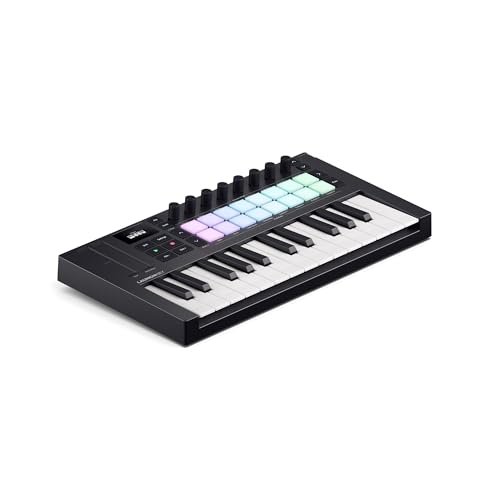
- 25 mini keys plus 16 polyphonic-aftertouch pads
- Scale, Chord, and Arpeggiator modes
- Broad DAW compatibility with included software
Best For: Portable producers needing keys and pads in one controller
Portable Beat Station

- Eight RGB-backlit MPC-style drum pads
- Eight assignable Q-Link control knobs
- Four programmable preset slots and USB power
Best For: Mobile beat makers and producers focused on pad control
Full-Range Studio Controller
Novation Launchkey 49 MK4 White

- 49 semi-weighted keys for broader playing range
- 16 pads with polyphonic aftertouch
- Nine faders plus pitch and modulation wheels
Best For: Studio players needing keys and extensive DAW control
Best Clip Launcher

- 64 RGB pads for Ableton clip launching
- 9 assignable faders for mixer control
- Includes Ableton Live Lite
Best For: Ableton Live performers and clip-based producers
Best Compact Keyboard

- 25 velocity-sensitive mini keys
- Built-in arpeggiator and octave controls
- Eight programmable preset slots
Best For: Portable songwriting and compact desktop setups
Best All-Around Keyboard

- 37 keys across three full octaves
- CV/Gate and MIDI I/O for hardware
- Built-in sequencer, pads, and knobs
Best For: Hybrid DAW and hardware-based music production
Best All-Around – Akai MPK Mini IV
The Akai Professional MPK Mini IV is one of the most versatile compact MIDI controllers for beat making, songwriting, and mobile production. Its 25 velocity-sensitive mini keys, MPC pads, assignable knobs, display, and expanded software integration provide substantial hands-on control without taking up much desk space.
Best For: Producers and content creators who want a portable controller with strong beat-making and performance features.
Pros:
- Combines 25 velocity-sensitive keys with eight pressure-sensitive MPC pads.
- Offers eight assignable 360-degree knobs, a color display, and push/turn encoder.
- Includes chord, scale, arpeggiator, and DAW-mapped transport features.
- USB-C, MIDI Out, bundled software, and learning resources support flexible setups.
Cons:
- Mini keys may be less suitable for players who prefer a full-size keyboard feel.
- Its many features may be more than beginners need for basic note entry.
The MPK Mini IV stands out when you want a compact MIDI controller that handles keys, pads, software navigation, and musical idea generation in one unit.
Best for Workflow – Arturia MiniLab 3
The Arturia MiniLab 3 is a streamlined MIDI controller for producers who want direct access to instruments, tracks, drums, and mixing controls. Its 25 velocity-sensitive keys, RGB pads, encoders, faders, display, and browsing knob make it a practical centerpiece for a compact computer-based setup.
Best For: Beginners and producers seeking an easy-to-use controller with integrated software and hands-on DAW workflow.
Pros:
- Provides 25 velocity-sensitive slim keys with synth action.
- Includes 16 velocity- and pressure-sensitive pads across two banks with RGB lighting.
- Four faders, eight rotary encoders, a display, and clickable browsing knob reduce mouse dependence.
- Includes Ableton Live Lite, Analog Lab Intro, UVI Model D, and a five-year limited warranty.
Cons:
- It uses slim mini keys rather than full-size keys.
- The plastic construction may feel less substantial than larger studio keyboards.
Choose the MiniLab 3 if your priority is a smooth, approachable workflow with plenty of software and track-control options in a compact white controller.
Best Value Classic – Akai MPK Mini MK3
The Akai Professional MPK Mini MK3 remains a capable compact MIDI controller for home studios and beat makers. It pairs 25 velocity-sensitive mini keys with MPC-style pads, assignable knobs, a four-way pitch and modulation control, and a built-in arpeggiator for hands-on production.
Best For: Beat makers and home-studio users who want a proven compact layout with bundled production software.
Pros:
- Includes eight backlit velocity-sensitive MPC pads with Note Repeat and Full Level.
- Eight 360-degree knobs provide control over plugins, mixing, and synth parameters.
- Four-way thumbstick handles pitch and modulation in a compact design.
- Comes with MPC Beats, virtual instruments, sound content, and a Splice trial.
Cons:
- Uses USB 2.0 Type-B rather than the newer USB-C connector.
- Its 25 mini keys offer less range and playing space than larger controllers.
- The listed manufacturer warranty is one year.
The MPK Mini MK3 is a sensible choice for straightforward beat production, especially if you value MPC-style pads and a familiar control layout over newer connectivity.
Best for Piano Range – M-Audio Keystation 49 MK3
The M-Audio Keystation 49 MK3 is a focused MIDI controller for players who need more keyboard range than compact 25-key models provide. Its 49 full-size velocity-sensitive keys, pitch and modulation wheels, volume fader, transport controls, and sustain-pedal input make it well suited to expressive software-instrument performance.
Best For: Keyboard players who prioritize full-size keys and a wider playing range for studio or stage setups.
Pros:
- Offers 49 full-size velocity-sensitive keys for more natural two-handed playing.
- Includes pitch and modulation wheels, octave buttons, and sustain-pedal input.
- Provides a volume fader plus transport and directional controls for software navigation.
- Plug-and-play USB operation requires no drivers or power supply and includes several software tools.
Cons:
- It does not include drum pads or rotary knobs for detailed beat and plugin control.
- The larger 49-key design takes more desk space than mini controllers.
- iOS connectivity requires an Apple to USB Camera Adapter, sold separately.
For musicians who mainly need a playable keyboard rather than an all-in-one production surface, the Keystation 49 MK3 offers useful range, expressive controls, and a straightforward connection to a DAW.
Compact Creative Hub – Novation Launchkey Mini 25 MK4
The Novation Launchkey Mini 25 MK4 is a versatile choice for musicians who want portable midi controllers with both keys and pad-based production features. Its 25 mini synth-action keys, 16 polyphonic-aftertouch pads, OLED display, and USB-C connection support playing, clip launching, sequencing, and sound design.
Best For: Portable producers and keyboard players who want an all-in-one controller for major DAWs.
Pros:
- Combines 25 keys with 16 responsive pads for playing, drumming, and clip launching.
- Scale, Chord, and Arpeggiator modes support faster idea generation.
- Works with Ableton Live, Logic, Cubase, Reason, Reaper, FL Studio, and Ardour.
- Includes Ableton Live Lite, Cubase LE, sounds, and Melodics lessons.
Cons:
- The mini 25-key layout offers less playing range than larger keyboards.
- Its single USB connection may limit more complex hardware setups.
Choose this Launchkey when portability and hands-on DAW control matter more than a full-size keyboard. It is especially flexible for producers who want keys, pads, chord tools, and sequencing functions in one compact unit.
Portable Beat Station – Akai Professional LPD8
The Akai Professional LPD8 is a compact pad-focused option among midi controllers, built for triggering samples, loops, and virtual instruments without adding a full keyboard. It combines eight RGB-backlit MPC-style pads with eight assignable Q-Link knobs in a lightweight USB-powered design.
Best For: Beat makers, DJs, and mobile producers who prioritize pads and tactile knob control.
Pros:
- Eight responsive RGB-backlit pads support sample, loop, and instrument triggering.
- Eight assignable knobs provide hands-on control of DAW and effect parameters.
- Four programmable preset slots allow quick recall of custom mappings.
- Plug-and-play USB operation works with Mac and PC without an AC adapter.
Cons:
- It has no piano keys for melodic keyboard performance.
- The compact pad layout provides fewer triggers than larger pad controllers.
The LPD8 is a practical pick when bag-friendly size and straightforward beat production are priorities. Its pads and knobs cover essential triggering and parameter control, while preset storage helps adapt it to different software setups.
Full-Range Studio Controller – Novation Launchkey 49 MK4 White
The Novation Launchkey 49 MK4 White is a full-range keyboard option for musicians comparing midi controllers for studio composition and DAW performance. It pairs 49 semi-weighted keys with 16 polyphonic-aftertouch pads, nine faders, pitch and modulation wheels, an OLED display, and USB-C connectivity.
Best For: Producers and keyboard players who need extended key range plus detailed DAW control.
Pros:
- 49 semi-weighted keys provide more range for melodies, chords, and arrangements.
- Sixteen pads support drumming, clip launching, step sequencing, and chord triggering.
- Nine faders, pitch/modulation wheels, and an OLED display add hands-on control.
- Scale and Chord modes, arpeggiation, and broad DAW support expand creative options.
Cons:
- The 49-key format is less portable than a compact mini controller.
- Its listed weight of 9.1 pounds may be a consideration for frequent travel.
This Launchkey is the stronger fit for players who want a conventional keyboard span without giving up pad-based production tools. Its larger footprint and expanded controls make it better suited to a dedicated studio or performance setup.
Best Clip Launcher – APC Mini MK2
The Akai Professional APC Mini MK2 is one of the most focused MIDI controllers for Ableton Live users. Its 8×8 RGB pad grid makes clip launching intuitive, while the faders and dedicated Drum and Note modes add practical control for live performance, looping, and home-studio production.
Best For: Ableton Live producers, clip-based performers, and musicians who want a compact live-performance controller.
Pros:
- 64 RGB pads provide visual feedback for launching clips and samples.
- Eight assignable faders plus a master fader offer hands-on mixer control.
- Pre-mapped 1-to-1 integration with Ableton Live 11.2.7 and later.
- USB-powered plug-and-play setup includes Ableton Live Lite.
Cons:
- Its feature set is especially oriented toward Ableton Live.
- It does not include piano-style keys for traditional melodic playing.
Choose the APC Mini MK2 if clip launching and mixer control matter more to you than a keyboard layout. It is a portable, purpose-built option for Ableton-centered workflows.
Best Compact Keyboard – LPK25 MK2
The Akai Professional LPK25 is a compact 25-key MIDI controller for portable songwriting, beat-making, and melody writing. Its velocity-sensitive mini keys, arpeggiator, octave controls, and USB-powered design make it a practical choice when desk space and portability are priorities.
Best For: Mobile producers, beginners, and musicians who need a small keyboard for DAWs and virtual instruments.
Pros:
- Velocity-sensitive 25-key layout supports expressive playing.
- Built-in arpeggiator, clock, sustain button, and octave controls expand performance options.
- Eight programmable preset slots help recall custom mappings.
- Works with popular software including GarageBand, Logic, Ableton Live, and FL Studio.
Cons:
- The 25-key mini-key layout offers less range than larger MIDI keyboards.
- Its USB-only connection may not suit setups needing additional MIDI or CV/Gate outputs.
The LPK25 is a straightforward choice among compact MIDI controllers. It delivers the essential keyboard controls for composing and performing without taking much room in a studio bag or desktop setup.
Best All-Around Keyboard – MPK Mini Plus
The Akai Professional MPK Mini Plus expands the typical compact MIDI controller with 37 keys, RGB MPC pads, assignable knobs, and connections for MIDI and CV/Gate equipment. It is designed for producers who want hands-on DAW control while also connecting synths, sound modules, or modular gear.
Best For: Producers who need a versatile keyboard controller for DAW work, beat-making, and external hardware.
Pros:
- 37-key layout provides three full octaves for melodic and harmonic parts.
- CV/Gate and MIDI I/O support connections to modular gear, synthesizers, and sound modules.
- Eight RGB MPC pads include Chords and Scales modes for performance.
- Built-in 64-step sequencer supports separate drum and melodic or chord tracks.
Cons:
- Its broader feature set may be more than beginners need.
- The controller is larger than a minimal 25-key option.
The MPK Mini Plus is the strongest fit here for users who want more than basic USB keyboard input. Its extra keys, hardware connectivity, pads, knobs, and sequencer make it a flexible centerpiece for a growing music setup.
How We Picked These Midi Controllers
We evaluated this selection by looking at the control layout, keyboard or pad configuration, portability, computer connectivity, software-focused workflow, and likely use case. The lineup includes compact 25-key controllers for mobile production, 37- and 49-key models for more playable arrangements, and dedicated pad controllers for beat making, clip launching, and hands-on software control.
We also considered how easily each controller can fit into a typical setup. A good MIDI controller should offer useful controls without creating unnecessary complexity, while providing enough flexibility for the way you actually make music.
Quick Comparison
| Best For | Recommended Type | What to Prioritize |
|---|---|---|
| Travel and small desks | 25-key mini keyboard | Compact size, USB power, useful knobs and pads |
| Playing chords and melodies | 49-key keyboard | Broader range, comfortable key layout, sustain support |
| Beat production | Pad controller | Responsive pads, assignable controls, low-latency triggering |
| Clip launching and live sets | Grid or pad controller | Clear layout, software integration, portable design |
| Balanced home-studio use | 37-key or feature-rich mini keyboard | Playable range plus knobs, pads, and transport controls |
Key Buying Factors for Midi Controllers
Keyboard Size and Playability
Choose 25 keys when portability matters most and you mainly enter bass lines, leads, chords, or short phrases. A 37-key model provides more room for two-handed ideas without taking up as much space as a full-size keyboard. A 49-key controller is better for extended melodies, piano-style parts, and arrangements that benefit from a wider range.
Pads, Knobs, and Workflow Controls
Pads are useful for drums, samples, clip launching, and finger performance. Knobs and sliders provide hands-on control over software instruments, effects, and mixer parameters. If you prefer recording rather than clicking, look for a layout that puts the controls you use most within easy reach.
Software Compatibility and Connectivity
Most modern controllers connect through USB and work with major music software, but bundled software and integration features vary. Check compatibility with your preferred DAW before buying, especially if you depend on automatic mapping. USB-C can be convenient for newer computers, while USB-powered designs are easier to move between setups.
Portability and Setup Space
Measure your desk, keyboard tray, or travel bag before choosing. Compact controllers are easy to store and carry, while larger keyboards offer a more natural playing range. Also consider whether you need a sustain-pedal input, MIDI connections, or a dedicated power supply for your setup.
Who Should Buy Which Midi Controllers?
For Beginners and Mobile Producers
A compact 25-key controller is usually the easiest starting point. It provides enough range for learning and composing while leaving room for a laptop and other gear.
For Keyboard Players and Arrangers
Choose a 37- or 49-key model if playing feel and range matter more than minimum size. These controllers are better suited to melodies, layered parts, and longer sessions at a desk.
For Beat Makers and Electronic Producers
A dedicated pad controller can be the most direct option for drum programming, sample triggering, and performance-oriented workflows. Select one with enough pads and assignable controls for your software.
For Live Performers
Prioritize reliable mapping, clear controls, and a layout you can operate quickly. Compact keyboards suit portable rigs, while larger models work well when you need broader melodic control during a set.