The right audio mixer can make a karaoke setup sound cleaner, louder, and easier to control. It balances microphones and music while adding useful features such as Bluetooth, USB recording, echo, DSP effects, and wireless microphone support.
These 10 options cover compact home mixers, dedicated karaoke processors, and larger systems for smart TVs or group performances. Use the buying guide below to match channels, connections, effects, and microphone support to your setup.
Best 10 Audio Mixer for Karaoke Setup Picks for 2026
Best All-in-One Karaoke Bundle
R4-PROS Wireless Karaoke Mixer

- Includes two UHF wireless microphones
- Independent dual-mic volume controls
- Bluetooth, USB, and 24 DSP effects
Best For: Home karaoke parties and duet singing
Best Compact Pro-Style Mixer

- Six-channel analog mixer
- D-PRE preamps with three-band EQ
- Rugged metal chassis
Best For: Compact setups with separate karaoke equipment
Best Effects-Focused Mixer

- 99 selectable DSP effects
- Seven-band main-output EQ
- USB recording and Bluetooth streaming
Best For: Detailed vocal shaping and flexible playback
Best Long-Range Wireless Mics

- Two UHF mics with 200-foot stated range
- Eight selectable frequencies per mic
- Optical, coaxial, RCA, and aux inputs
Best For: Wireless karaoke events with powered speakers
Flexible 4-Channel Pick

- Four channels with mic, instrument, RCA, and 6.35mm inputs
- Bluetooth and USB playback plus PC recording
- 48V phantom power and 99 DSP effects
Best For: Versatile home karaoke and recording setups
Wireless Karaoke Specialist
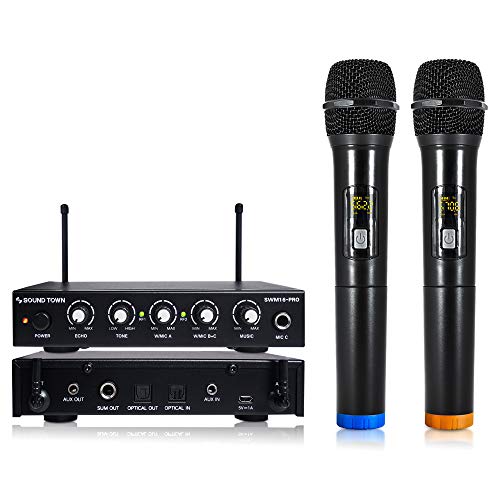
- Includes two UHF handheld microphones
- Optical and analog connections for TVs and soundbars
- Adjustable mic volume, echo, and tone
Best For: TV-based home karaoke with wireless microphones
Expanded Input Choice

- Three XLR inputs plus RCA and 6.35mm stereo inputs
- USB and Bluetooth playback with recording functions
- Echo, delay, phantom power, and headphone monitoring
Best For: Small karaoke groups needing multiple wired inputs
Feature-Rich KTV Processor

- Anti-howling function helps control feedback
- Bluetooth, USB, optical, and AUX connectivity
- Multiple mic, speaker, and subwoofer outputs
Best For: Flexible home KTV systems with multiple audio sources
Precision Vocal Control

- 13-band EQ with echo, reverb, and key shifting
- One-touch vocal enhancement and feedback suppression
- Bluetooth, USB, optical, coaxial, AUX, RCA, and XLR
Best For: Advanced vocal tuning in home or professional karaoke systems
Best All-in-One Karaoke Bundle – R4-PROS Wireless Karaoke Mixer
If you want an audio mixer for karaoke setup that includes microphones and music playback features, the R4-PROS combines a four-channel mixer with two UHF wireless microphones. Independent mic controls make it easier to balance duet vocals, while Bluetooth, USB, and multiple analog connections support varied home entertainment setups.
Best For: Home karaoke parties, duets, and users who want wireless microphones included.
Pros:
- Includes two UHF wireless microphones with stable, low-latency transmission.
- Independent volume controls for microphone channels A and B help balance singers.
- Offers Bluetooth streaming, USB audio, 24 DSP effects, and 48V phantom power.
- Supports XLR, 1/4-inch TRS, RCA, and 3.5mm connections.
Cons:
- Requires separate speakers or another suitable sound-output setup.
- The larger feature set may be more than needed for a simple karaoke system.
The R4-PROS is a versatile choice when a karaoke mixer, wireless microphones, vocal effects, and recording connectivity are all priorities. Its dual-mic controls are especially useful for group singing and duets.
Best Compact Pro-Style Mixer – Yamaha MG06
The Yamaha MG06 is a straightforward audio mixer for karaoke setup when you value a compact, durable analog design over built-in Bluetooth or USB playback. Its six inputs, D-PRE preamps, EQ, high-pass filters, and compressors provide practical control for microphones and connected audio equipment.
Best For: Buyers who already have karaoke sources and want a reliable compact mixer with hands-on controls.
Pros:
- Provides six input channels in a compact standalone design.
- D-PRE preamps are designed for natural bass and smooth high frequencies.
- Three-band EQ and high-pass filters help shape vocals and reduce unwanted noise.
- Rugged, impact-resistant metal chassis is suited to regular use.
Cons:
- Does not include USB connectivity or Bluetooth audio streaming.
- Does not include wireless microphones or built-in karaoke effects.
The MG06 is best viewed as a durable analog control center rather than a complete karaoke package. It makes sense for setups using separate playback devices, microphones, and speakers.
Best Effects-Focused Mixer – 4-Channel USB Karaoke Mixer
This four-channel board is an audio mixer for karaoke setup that emphasizes vocal shaping and flexible playback. It includes 99 DSP effects, channel-level three-band EQ, a seven-band main-output EQ, Bluetooth streaming, and USB recording and playback for compatible Mac and PC setups.
Best For: Karaoke users who want extensive effects and detailed EQ control for vocals and music.
Pros:
- Provides 99 selectable DSP effects for reverb and other sound adjustments.
- Includes two XLR mic inputs and two stereo line inputs.
- Seven-band output EQ allows detailed main-mix tuning.
- Supports Bluetooth streaming, USB recording, and USB playback.
Cons:
- Bluetooth range is specified at up to 15 feet.
- It is a mixer rather than a complete system with microphones and speakers.
With its extensive effects library and output EQ, this model suits users who want to experiment with karaoke sound. The USB and Bluetooth features also make it practical for music playback and basic recording.
Best Long-Range Wireless Mics – Rockville RKI60
The Rockville RKI60 is an audio mixer for karaoke setup built around dual wireless microphones and broad source compatibility. It includes two UHF handheld mics with a stated 200-foot operating range, adjustable echo, mic priority, and optical, coaxial, RCA, and auxiliary inputs.
Best For: Home entertainment and karaoke events that need wireless microphones and multiple audio-source connections.
Pros:
- Includes two UHF microphones with eight selectable frequencies per microphone.
- Stated wireless operating range reaches up to 200 feet.
- Accepts optical, coaxial, RCA, auxiliary, and wired microphone inputs.
- Includes cables, batteries, adjustable echo, and mic priority control.
Cons:
- Requires an amplifier, AV receiver, or powered speakers; passive speakers alone will not work.
- Outputs through RCA stereo connections, which may limit some setups.
The RKI60 is a strong fit when wireless microphone range and input variety matter most. Plan for powered speakers or an amplifier, since this unit does not provide amplification for passive speakers.
Flexible 4-Channel Pick – Bluetooth Recording Mixer
If you need an audio mixer for karaoke setup that can also handle recording, monitoring, and multiple input types, this four-channel Aveek model is a versatile option. It combines microphone and instrument inputs with Bluetooth, USB playback, PC recording, phantom power, and onboard effects.
Best For: Karaoke systems that also support condenser microphones, music playback, home recording, or live streaming.
Pros:
- Two XLR/6.35mm inputs support microphones or guitars, while RCA and 6.35mm inputs accommodate players, keyboards, or computers.
- Built-in Bluetooth and USB flash-drive playback make it easy to add backing tracks.
- PC recording, headphone monitoring, 48V phantom power, and 99 DSP effects provide useful flexibility.
- Three-band EQ, gain controls, and output fader help shape the mix.
Cons:
- Bluetooth is for music playback rather than sending audio to an output device.
- Bluetooth range is specified at about 15 feet.
- Its 4-channel layout may be limiting for larger karaoke groups.
The F4 is a strong all-around choice when a karaoke mixer needs more than basic microphone volume control. Its recording and effects features add value, while the channel count keeps the unit relatively compact.
Wireless Karaoke Specialist – 16-Channel Mic Mixer System
For a karaoke setup centered on wireless microphones and a TV or soundbar, the Sound Town SWM16-PRO takes a more dedicated approach. It combines two handheld UHF microphones with a mixer receiver featuring optical and analog connections for straightforward home theater integration.
Best For: Home karaoke with a smart TV, soundbar, home receiver, or external speaker system.
Pros:
- Includes two handheld wireless microphones with 16 selectable UHF frequencies.
- Optical input and output support connections to compatible smart TVs, soundbars, and home theater equipment.
- Rotary controls adjust microphone volume, echo, and tone.
- Also provides 3.5mm and 6.35mm connections for flexible analog setups.
Cons:
- It is designed around the included wireless microphone system rather than broad multichannel instrument mixing.
- Setup requires careful volume balancing between the external speakers, microphones, and main mixer.
- Compatibility depends on having suitable optical or analog inputs and outputs on the connected equipment.
This system is a practical match for living-room karaoke because it includes the microphones and connections most likely to be needed with a TV-based setup. Its echo and tone controls add basic vocal adjustment without requiring a separate mixer.
Expanded Input Choice – 5-Channel USB Karaoke Mixer
This five-channel Aveek is a useful audio mixer for karaoke setup when you want several wired sources, backing-track playback, and simple recording in one compact board. It adds three XLR inputs, stereo line connections, Bluetooth, USB functions, effects, and headphone monitoring.
Best For: Small karaoke, streaming, podcasting, or party setups that need multiple microphones and stereo source inputs.
Pros:
- Three XLR inputs plus 6.35mm and RCA stereo inputs support microphones, guitars, computers, keyboards, and CD players.
- USB drive playback and recording simplify backing-track use and audio capture.
- Bluetooth streaming works with phones, tablets, and computers within about 15 feet.
- Includes 48V phantom power, echo and delay effects, EQ and gain controls, and headphone monitoring.
Cons:
- Bluetooth, USB, and 4/5-channel functions cannot be used simultaneously.
- Bluetooth is not intended to connect an output device and works with active systems.
- The supplied notes specify two-band EQ, offering less tonal adjustment than a three-band design.
The five-channel layout gives this model a useful edge for karaoke groups that need multiple microphone inputs. Its simultaneous-use limitation is important to plan around, but the combination of effects, playback, recording, and monitoring remains flexible.
Feature-Rich KTV Processor – K-6 Digital Karaoke Mixer
The K-6 is a strong choice if you need an audio mixer for karaoke setup with dedicated vocal effects, multiple source options, and anti-howling assistance. It supports Bluetooth, USB, optical, AUX, and several microphone connections, making it suitable for flexible home KTV systems.
Best For: Home karaoke users who want extensive inputs, DSP-style effects, and remote control.
Pros:
- One-button howling prevention helps suppress feedback.
- Supports Bluetooth, USB, optical, AUX, and multiple microphone inputs.
- Offers echo, reverb, delay, repeat, treble, midrange, and bass adjustments.
- Includes subwoofer, center, surround, main, and REC outputs.
Cons:
- Some fine adjustments require a screwdriver and access to hidden knobs.
- Its broad output and control layout may be more than a basic karaoke setup needs.
The K-6 stands out for connectivity and system control. It is especially appealing when you want to integrate several playback devices and speakers while retaining detailed microphone and vocal-effect adjustments.
Complete Wireless Package – 5-Channel Karaoke Mixer with Mic Set
This 5-channel system is a practical audio mixer for karaoke setup when you also need microphones included. It combines two UHF wireless handheld mics with independent channel controls, Bluetooth playback, and a USB audio interface for home karaoke, parties, and small performances.
Best For: Families and hosts who want a ready-to-use karaoke mixer with two wireless microphones.
Pros:
- Includes two UHF wireless microphones with up to 180 feet of stated reception range.
- Independent channel controls include volume, echo, gain, and bass, mid, and treble adjustment.
- USB audio interface supports PC or smartphone recording and playback.
- Package includes cables, batteries, power adapter, and microphone accessories.
Cons:
- The two wireless microphones share channel 2.
- Bluetooth transmission is listed at up to 35 feet, shorter than the stated microphone reception range.
- Microphones require two AA batteries each.
For buyers starting or expanding a family karaoke system, the included microphones and accessories add convenience. The five-channel layout also leaves room for external playback devices and other connected sources.
Precision Vocal Control – DSP Karaoke Audio Processor
The DSP-11 is designed for an audio mixer for karaoke setup where vocal clarity and feedback control are priorities. Its LCD display, remote control, 13-band EQ, vocal enhancement, and multiple digital inputs provide detailed control for home systems, events, studios, or live streaming.
Best For: Karaoke users who want advanced vocal processing, feedback suppression, and digital connectivity.
Pros:
- DSP processing provides vocal effects, noise reduction, and multi-section audio adjustment.
- One-touch vocal enhancement, mic priority, and FBX suppression simplify operation.
- Includes a 13-band EQ plus key shifting, echo, and reverb controls.
- Offers Bluetooth, USB, optical, coaxial, AUX, RCA, and XLR connections.
Cons:
- It has two microphone inputs, which may not suit larger microphone setups.
- The advanced processing controls may be unnecessary for users seeking a simple mixer.
- The supplied notes do not specify a warranty or software-update support.
The DSP-11 is a compelling option for tuning vocals precisely and managing feedback from a central control panel or remote. Its four XLR outputs and dedicated sub outputs also make it suitable for more involved speaker and amplifier configurations.
How We Picked the Best Audio Mixer for Karaoke Setup
We focused on the features that matter most during karaoke: microphone input count, independent volume controls, vocal effects, feedback or anti-howling functions, music playback options, and connection flexibility. We also considered whether each mixer is better suited to a basic home system, a smart-TV setup, live streaming, or a larger room.
Products with wireless microphones were evaluated for convenience, while conventional mixers such as the Yamaha MG06 were considered for users who already own microphones and want dependable audio control. USB, Bluetooth, optical, AUX, and phantom-power support were treated as useful advantages when they fit the intended use.
Quick Comparison
- Simple home karaoke: Choose a compact Bluetooth or USB mixer with straightforward microphone controls.
- Wireless convenience: Look for a bundled system with one or two UHF microphones and independent mic volume adjustment.
- Smart-TV integration: Optical or AUX inputs can simplify connections to modern televisions and streaming devices.
- Vocal effects: DSP echo, reverb, and vocal processing help create a more traditional karaoke sound.
- Recording or streaming: A USB recording interface is useful for capturing performances or routing audio to a computer.
- Multiple performers: A higher channel count provides room for extra microphones, instruments, or playback sources.
Key Buying Factors for an Audio Mixer for Karaoke Setup
Inputs and Microphone Control
Count the microphones and music sources you plan to use at the same time. Independent microphone volume controls are especially helpful when singers have different vocal levels. XLR inputs are preferable for many wired microphones, while bundled wireless systems offer faster setup.
Effects and Feedback Control
Echo and reverb can make vocals sound fuller, but adjustable controls are more useful than a long list of presets. Anti-howling or feedback-reduction features are valuable when microphones and speakers must operate close together.
Playback and Recording Connections
Bluetooth is convenient for phones and tablets, while USB can support playback, recording, or computer-based streaming depending on the model. Optical input is worth considering if your karaoke source is a smart TV with digital audio output. Check the required cables and output type before buying.
Power and Compatibility
Some mixers provide 48V phantom power for compatible condenser microphones, but that feature is not necessary for most basic karaoke microphones. Confirm speaker outputs, input levels, wireless frequency requirements, and whether the mixer works with your amplifier or powered speakers.
Who Should Buy Which Audio Mixer for Karaoke Setup?
Choose a compact mixer for occasional family karaoke, a phone-based music source, and one or two microphones. Choose a bundled wireless system if minimizing cables and setup time matters most. Choose a dedicated DSP karaoke processor if adjustable echo, reverb, equalization, or anti-feedback control is central to your setup. Choose a conventional multi-channel mixer for live streaming, recording, instruments, or future expansion. Finally, select a higher-channel or optical-input system for larger groups and smart-TV-centered karaoke rooms.