Choosing an audio mixer for beginners can feel complicated when channel counts, phantom power, USB connectivity, and monitoring features all compete for attention. The right model depends less on having the most controls and more on matching the mixer to your microphones, instruments, computer, and intended use.
We selected 10 accessible options spanning compact analog mixers, USB-equipped sound boards, gaming interfaces, and podcast bundles. Use the guide below to narrow your choices by setup, connectivity, controls, and room to grow.
Best 10 Audio Mixer for Beginners Picks for 2026
Feature-Packed Starter
FULUODE CT-80S 8-Channel Mixer

- Eight channels for microphones and instruments
- Bluetooth, USB, MP3, and recording support
- 48V phantom power with reverb effects
Best For: Karaoke, small events, and flexible home setups
Reliable Analog Pick

- Six inputs with D-PRE preamps
- EQ, filters, and one-knob compression
- Rugged metal chassis
Best For: Hands-on analog mixing and small performances
Best Connected Option

- Plug-and-play PC recording via USB
- Bluetooth and USB-drive playback
- Three XLR inputs with 48V phantom power
Best For: Podcasting, livestreaming, and home recording
Simple Compact Choice

- Compact five-channel analog design
- RCA playback and recording connections
- Phantom power and two-band EQ
Best For: Small analog setups and basic vocal mixing
Best Beginner Gaming Mixer

- Four individually controlled channels
- XLR input with 48V phantom power
- Mute, monitoring, RGB, and voice effects
Best For: Beginner gamers, streamers, and podcasters
Best Feature-Rich Beginner Mixer
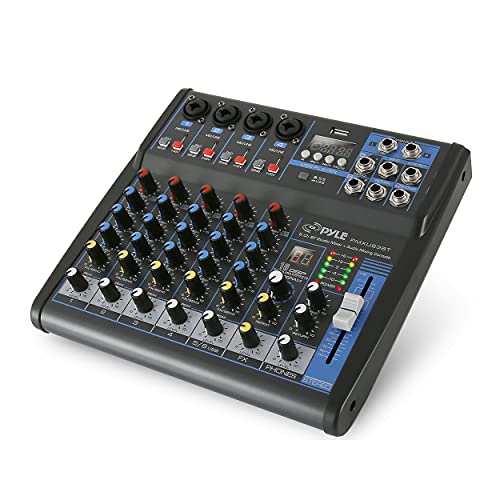
- Six channels for microphones and stereo sources
- Bluetooth, USB, flash, and MP3 playback
- 3-band EQ, phantom power, and DSP effects
Best For: Home audio, karaoke, live performance, and small bands
Best All-in-One Beginner Bundle
MAONO Podcast Equipment Bundle

- Includes mixer, condenser mic, tripod, and accessories
- Supports up to two people and four devices
- Built-in effects, monitoring, denoise, and voice changing
Best For: New podcasters and livestreamers using 3.5mm devices
Simple Signal Routing
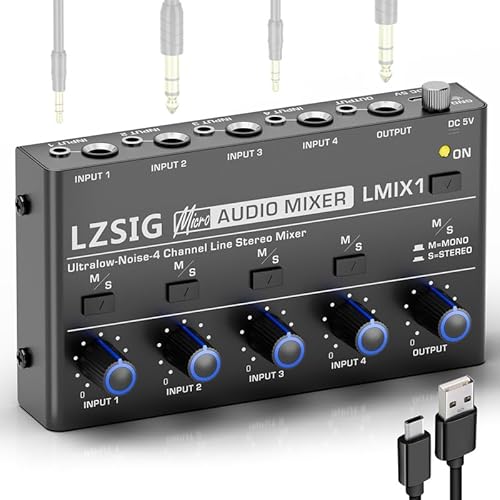
- Combines up to four line-level sources
- Supports 3.5mm and 6.35mm connections
- Switches between mono and stereo output
Best For: Beginners mixing keyboards, instruments, computers, or consoles
Streaming Control Center

- Adds XLR input with 48V phantom power
- Includes effects, sound pads, and noise reduction
- Supports computers, phones, tablets, and consoles
Best For: New gamers and streamers using compatible XLR microphones
All-in-One Live Production
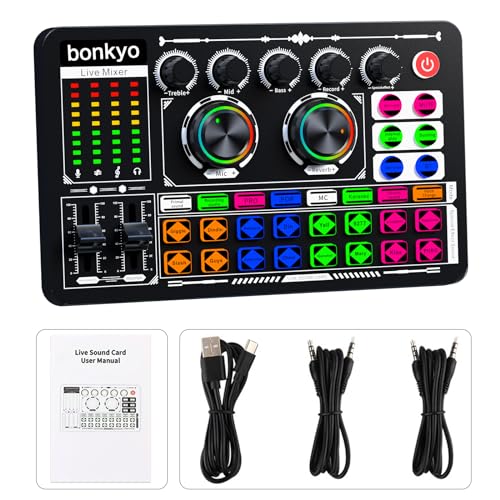
- Includes DSP effects and voice-changing modes
- Supports up to three simultaneous broadcast devices
- Provides multiple microphone and headphone connections
Best For: Beginners making podcasts, live streams, gaming content, or singing broadcasts
Feature-Packed Starter – FULUODE CT-80S 8-Channel Mixer
If you want an audio mixer for beginners with plenty of built-in features, the FULUODE CT-80S offers eight channels, Bluetooth playback, USB connectivity, MP3 support, and reverb controls. Its 48V phantom power also supports compatible condenser microphones, making it flexible for karaoke, small performances, meetings, and home recording setups.
Best For: Beginners who want an all-in-one mixer for karaoke, live music, events, or basic studio use.
Pros:
- Eight channels accommodate microphones, instruments, and other sources.
- Includes Bluetooth, USB, MP3 playback, and USB recording features.
- Offers 48V phantom power and built-in reverb functionality.
- Ultra-thin design with a large LED display.
Cons:
- Its many functions may take beginners some time to learn.
- The unit uses a corded 110V American-plug power setup.
The CT-80S is a practical choice when convenience and connectivity matter more than a minimal control layout. It provides room to grow while keeping playback and recording tools in one console.
Reliable Analog Pick – Yamaha MG06 6-Input Mixer
The Yamaha MG06 is a straightforward audio mixer for beginners who prefer hands-on analog controls and dependable construction. Its six inputs, D-PRE preamps, three-band EQ, high-pass filters, and one-knob compressors provide useful tone-shaping tools for recording, lectures, and small performances.
Best For: Beginners who want a compact analog mixer for vocals, instruments, presentations, or live performance.
Pros:
- Six-input layout offers useful flexibility in a compact format.
- D-PRE preamps are designed for natural bass and smooth highs.
- Three-band EQ, high-pass filters, and one-knob compressors simplify sound shaping.
- Rugged, impact-resistant powder-coated metal chassis.
Cons:
- No USB connectivity for direct computer recording.
- Analog-only operation may require additional equipment for computer-based workflows.
The MG06 is a strong fit for learners who want to understand traditional mixing without navigating Bluetooth or digital playback features. Its durable build and focused controls make it an uncomplicated starting point.
Best Connected Option – Aveek 5-Channel USB Mixer
For beginners seeking an audio mixer for beginners that connects easily to modern devices, the Aveek five-channel mixer combines USB recording, Bluetooth streaming, USB-drive playback, and headphone monitoring. It also includes three XLR inputs with switchable 48V phantom power, plus echo and delay effects for streaming, podcasts, meetings, and small shows.
Best For: New podcasters, livestreamers, and home users who need computer recording and wireless playback.
Pros:
- Built-in recording interface supports plug-and-play PC recording.
- Bluetooth and USB-drive playback add convenient music options.
- Three XLR inputs include switchable 48V phantom power.
- Headphone monitoring, EQ, echo, and delay controls support live use.
Cons:
- Bluetooth, USB, and four/five-channel functions cannot be used simultaneously.
- Bluetooth range is specified at about 15 feet.
- Outputs are intended for active speakers or a power amplifier rather than passive speakers alone.
The Aveek offers an approachable feature set for content creation and casual recording. Beginners should note the mode limitation, but its USB interface and monitoring options make setup relatively accessible.
Simple Compact Choice – Mackie Mix5 5-Channel Mixer
The Mackie Mix5 is a compact audio mixer for beginners who want a focused control panel without extra digital features. It provides one mic/line input with phantom power, two stereo quarter-inch line inputs, dedicated RCA playback and recording connections, two-band EQ, and main left/right outputs.
Best For: Beginners building a small analog setup for vocals, playback, simple recording, or presentations.
Pros:
- Compact design is easy to place in small workspaces.
- Includes a mic/line input, two stereo line inputs, and RCA connections.
- Phantom power supports compatible studio condenser microphones.
- Low-noise, high-headroom performance with straightforward tone shaping.
Cons:
- Only one mic/line input limits multi-microphone setups.
- No USB or Bluetooth connectivity is listed.
- Two-band EQ offers less control than mixers with three-band EQ.
The Mix5 makes sense for a beginner who values simplicity and a small footprint. It is best suited to basic analog mixing rather than computer-centered recording or larger multi-mic productions.
Best Beginner Gaming Mixer – FIFINE Ampligame SC3W
For beginners seeking an audio mixer for beginners setup, the FIFINE Ampligame SC3W offers four individually controlled channels, USB connectivity, and XLR microphone support. Its faders, mute button, monitoring, and plug-and-play PC support keep everyday adjustments straightforward.
Best For: Beginner streamers, gamers, and podcasters who want hands-on controls, XLR microphone support, and RGB-focused features.
Pros:
- Four independent control channels make it easier to balance connected devices.
- XLR input and built-in 48V phantom power support compatible condenser microphones.
- Includes mute, volume, real-time monitoring, voice-changing, and customizable sound-button features.
- Supports dual-PC streaming and has USB plug-and-play connectivity for PC.
Cons:
- Its entertainment-focused RGB and voice effects may be unnecessary for simple recording.
- The listed 3.5mm output and gaming-oriented design may not suit larger studio setups.
The SC3W is a practical starting point when you want physical faders without a complicated control surface. It is especially appealing for live streaming, though users should confirm their microphone and connection requirements before buying.
Best Feature-Rich Beginner Mixer – Pyle PMXU63BT 6-Channel Mixer
The Pyle PMXU63BT is a versatile audio mixer for beginners who want room to connect microphones, stereo sources, and wireless devices. It combines six channels with Bluetooth, USB, an MP3 player, 3-band EQ, and 48V phantom power in a compact steel chassis.
Best For: Beginners building a flexible home, karaoke, live-performance, or small-band audio setup.
Pros:
- Six channels provide more connection options than a basic compact mixer.
- Supports XLR and unbalanced 1/4-inch inputs, with 48V phantom power for compatible microphones.
- Bluetooth, USB, flash-drive, and built-in MP3 playback add convenient source options.
- Includes 3-band EQ, LED peak indicators, and 16-bit DSP effects.
Cons:
- At 3.8 pounds and nearly 10 inches wide, it is less portable than smaller beginner mixers.
- Its wider feature set may take longer to learn than a simple two-channel interface.
The PMXU63BT makes sense for beginners who expect their setup to grow beyond a single microphone. Its channel count and playback options are useful for live use, while the physical controls offer a clear path to learning basic mixing.
Best All-in-One Beginner Bundle – MAONO Podcast Equipment Bundle
For beginners who want to start recording quickly, the MAONO Podcast Equipment Bundle combines a mixer, 3.5mm condenser microphone, cable, tripod, and accessories. It is designed for podcasting and live streaming, with simple controls for effects, monitoring, voice changes, and multiple connected devices.
Best For: New podcasters and livestreamers who need a complete 3.5mm microphone setup for a PC, phone, or tablet.
Pros:
- Includes the mixer, condenser microphone, tripod, cable, windscreen, and charging cable.
- Supports up to two people, four devices, and four platforms for simultaneous streaming.
- Offers built-in and recordable sound effects, reverb, voice changing, and denoise controls.
- Works with many Windows, Mac, iOS, Android, smartphone, and tablet setups.
Cons:
- The AM200 supports 3.5mm microphone input only and does not support phantom power.
- Instruments such as guitars and keyboards require an additional 6.35mm-to-3.5mm adapter.
- Phones without a 3.5mm jack need a separate OTG adapter.
The MAONO bundle is a convenient entry point because the core recording accessories are included. Its 3.5mm-only microphone design makes it less suitable for users planning an XLR upgrade, but it is well matched to straightforward podcast and streaming workflows.
Simple Signal Routing – Compact 4-Channel Mixer
If you need an audio mixer for beginners to combine several line-level sources, the LZSIG Mini Audio Mixer keeps the setup straightforward. It blends up to four sources—such as keyboards, electronic drums, guitars, computers, CD players, or gaming consoles—into one mono or stereo output.
Best For: Beginners building a compact music, gaming, or home audio setup with multiple line sources.
Pros:
- Four inputs support a range of 3.5mm and 6.35mm TS/TRS connections.
- Mono/stereo switching adds flexibility for different routing needs.
- Ultra-low-noise design uses a power-management chip and low-noise op-amps.
- Small footprint suits desktop setups and basic system expansion.
Cons:
- Power adapter is sold separately.
- Designed for line mixing rather than a full microphone-focused recording setup.
This is a practical entry point if your priority is combining several existing audio devices without a complex control surface. Its limited channel count and separate power-adapter requirement are worth planning for.
Streaming Control Center – MAONO G1 Neo Gaming Mixer
The MAONO G1 Neo is an audio mixer for beginners who want a more interactive streaming setup. It combines an XLR microphone input, 48V phantom power, one-click noise reduction, sound pads, voice effects, Bluetooth accompaniment, monitoring, and RGB lighting in a compact interface.
Best For: New gamers and streamers using XLR microphones with OBS, Discord, Twitch, TikTok, YouTube, or similar platforms.
Pros:
- Built-in preamp and 48V phantom power support compatible XLR condenser microphones.
- One-click mute, noise reduction, loopback, and direct monitoring simplify streaming control.
- Voice changing, reverb, sidechain, and customizable sound pads add creative options.
- Works with phones, computers, tablets, PS4, and PS5.
Cons:
- Not compatible with USB microphones or Xbox.
- Requires careful gain and volume adjustment for the best experience.
- Its gaming-focused effects may be unnecessary for simple music mixing.
For a beginner streamer, the G1 Neo offers many controls without requiring separate effect hardware. Confirm your microphone and platform compatibility first, especially if you use a USB microphone or Xbox.
All-in-One Live Production – F999 Streaming Mixer
The F999 is an audio mixer for beginners who want live-streaming and podcast features in one device. Its built-in DSP provides voice effects, reverb, noise reduction, accompaniment control, monitoring, and multiple connection options for phone, tablet, and computer broadcasts.
Best For: Beginners creating podcasts, live broadcasts, gaming streams, or singing content with multiple participants or devices.
Pros:
- Offers 16 special effects, eight tone modes, five recording options, and four voice-changing modes.
- Supports up to three devices for simultaneous live broadcasting.
- Includes two microphone inputs, two condenser-microphone connections, and two headphone outputs.
- Provides real-time monitoring, accompaniment input, and a dedicated noise-reduction control.
Cons:
- The large feature set may take time for beginners to learn.
- Supplied details do not specify a USB microphone connection.
- Its live-production features may be more than needed for basic two-source mixing.
The F999 is appealing when flexibility matters more than minimalism. It is particularly suited to creators who need multiple microphones, headphones, or connected broadcast devices, while the included manual can help with the initial setup.
How We Picked the Best Audio Mixer for Beginners
We focused on mixers that offer a practical learning curve, useful input options, straightforward controls, and features suited to common first setups. The selection includes compact analog boards for simple mixing, USB models for computer recording, and dedicated gaming or podcast interfaces for users who prioritize live communication and content creation.
We also considered channel flexibility, microphone compatibility, monitoring options, portability, and value. Features such as Bluetooth, built-in effects, MP3 playback, USB recording, and 48V phantom power can be helpful, but they are most valuable when they match your actual workflow.
Quick Comparison
| Best For | What to Prioritize | Recommended Type |
|---|---|---|
| Basic music mixing | Clean preamps, individual level controls, stereo inputs | Compact analog mixer |
| Podcasting and recording | USB interface, microphone support, headphone monitoring | USB mixer or podcast bundle |
| Gaming and streaming | Fast mute controls, volume adjustment, computer compatibility | Gaming audio interface |
| Small live setups | More channels, phantom power, effects, playback | Multi-channel mixer |
| Simple multi-device routing | Low noise, compact design, multiple inputs | Mini line mixer |
Key Buying Factors for an Audio Mixer for Beginners
Inputs and Channel Count
Count every source you may connect at the same time: microphones, instruments, phones, computers, and playback devices. A five- or six-channel mixer is often enough for a small home setup, while larger boards provide more room for multiple microphones or instruments.
USB, Bluetooth, and Computer Connectivity
USB is important if you want to record directly to a computer or stream digital audio. Bluetooth and MP3 playback are convenient for background music, but they do not replace a proper USB recording connection. Check whether the mixer supports the operating system and routing workflow you plan to use.
Phantom Power and Microphone Compatibility
Condenser microphones typically need 48V phantom power, while many dynamic microphones do not. Confirm that the mixer has the correct XLR inputs and enough gain for your microphone. If you use a 3.5mm microphone, choose a compatible interface or bundle rather than relying on an adapter.
Monitoring and Controls
A dedicated headphone output, clear level controls, mute buttons, and useful metering make learning easier. For streaming or gaming, quick-access controls may matter more than advanced equalization. For music, independent channel adjustment and a master output are usually more important.
Who Should Buy Which Audio Mixer for Beginners?
Choose a compact analog model such as the Yamaha MG06 or Mackie Mix5 if you want dependable controls for microphones, instruments, or small stereo sources. Consider the Aveek, FULUODE, or Pyle options if you need more channels, playback features, Bluetooth, or phantom power for a broader home setup.
Streamers and gamers should look closely at the FIFINE Ampligame SC3W and MAONO G1 Neo, which emphasize accessible real-time control and computer-focused workflows. The MAONO podcast bundle is a practical starting point for buyers who want a more complete microphone-and-mixer setup. For very simple routing, the LZSIG mini mixer may be sufficient, while the F999-style live sound card suits users seeking streaming-oriented effects and controls.
Before buying, verify the connector types, included accessories, computer compatibility, and whether the mixer provides the outputs your speakers or headphones require. Starting with the simplest setup that supports your current sources usually produces better results than paying for features you will not use.