Choosing the best DJ mixer depends on how you perform, which software you use, and whether you need a laptop-free setup. This roundup compares 10 popular DJ controllers and standalone systems across beginner, mobile, and performance-focused categories.
Use the buying guide below to narrow your choices by features, portability, connectivity, control layout, and long-term value.
Best 10 Dj Mixer Picks for 2026
Flagship Open-Format Control

- Four-channel layout with club-style workflow
- Track Separation for live mashups
- Works with rekordbox and Serato DJ Pro
Best For: Serious hobbyists, mobile DJs, and professionals
Portable Standalone Power
- Battery-powered laptop-free operation
- Wi-Fi streaming and Engine DJ OS
- Multiple outputs, media inputs, and onboard FX
Best For: Mobile DJs and standalone performers
Gig-Ready All-in-One System

- Standalone USB playback for rekordbox sets
- 10.1-inch touchscreen with CDJ-style layout
- Performance pads, Beat FX, and pro outputs
Best For: Home, mobile, and small-venue DJs
Accessible Two-Deck Starter
Hercules DJControl Inpulse 500

- Two-deck controller for Serato and DJUCED
- Built-in audio interface and input mixer
- Jog wheels, RGB pads, and Beatmatch Guide
Best For: Beginner and intermediate computer DJs
Premium Standalone Pick
- Four-deck standalone DJ controller
- Built-in speakers and 7-inch touchscreen
- Wi-Fi, Bluetooth, USB, and SD connectivity
Best For: Mobile, streaming, and club DJs seeking laptop-free control
Best Learning Controller
- Beginner-friendly two-channel layout
- Smart Fader simplifies beat blending
- Works with computers, mobile devices, and streaming services
Best For: New DJs building skills with room to grow
Best Party Starter

- Built-in beat-synchronized LED light show
- Beginner aids with pads, stems, and Fade FX
- Compact USB-powered design with Bluetooth MIDI
Best For: Casual DJs and parties needing an easy, portable setup
Best Beginner DJ Controller

- Smart Fader assists with beatmatching
- USB-C powered and highly portable
- Works with rekordbox, djay, and Serato Lite
Best For: First-time DJs seeking guided, portable mixing
Best DJ Controller With Lights
- Built-in lights sync to your mix
- Includes two decks and performance pads
- Integrated mixer with EQ and crossfader
Best For: Casual parties and beginner home practice
Best Guided DJ Mixer
Hercules DJControl Inpulse 200 MK3
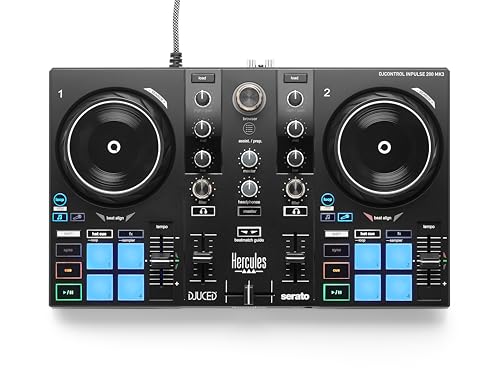
- Beatmatch Guide LEDs support learning
- Includes tutorials and Intelligent Music Assistant
- Portable controller with stem separation
Best For: Beginners building skills with guided practice
Flagship Open-Format Control – Pioneer DJ DDJ-FLX10
The Pioneer DJ DDJ-FLX10 is a serious four-channel dj mixer-style controller for DJs who want a club-oriented workflow with modern remix tools. Its Track Separation feature, large jog wheels, and support for rekordbox and Serato DJ Pro make it suitable for prepared sets and live performance.
Best For: Serious hobbyists, mobile DJs, and professionals building an open-format setup.
Pros:
- Track Separation isolates vocals, drums, and instruments for live mashups.
- Four-channel layout and pro FX mirror a CDJ and DJM booth workflow.
- Built-in DMX output can control compatible lighting setups.
- Multicolor jog-wheel displays show waveforms, artwork, and playing parts.
Cons:
- Its 14.8-pound size and performance-focused feature set may be more than beginners need.
- It requires a computer-based setup with rekordbox or Serato DJ Pro.
The DDJ-FLX10 is a strong choice when flexibility and professional-style control matter more than portability. It is especially appealing for DJs who want one controller that can support evolving open-format performances.
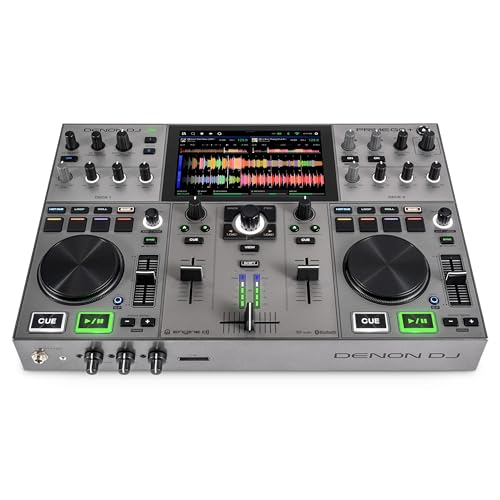
Portable Standalone Power – Denon DJ PRIME GO+
The Denon DJ PRIME GO+ is a portable dj mixer-style standalone controller for performances without a laptop. Battery power, Wi-Fi streaming, built-in effects, and multiple media inputs give mobile DJs a flexible system for sets away from a traditional booth.
Best For: DJs who prioritize portability, standalone operation, and access to streamed or stored music.
Pros:
- Battery-powered design supports laptop-free performances.
- Wi-Fi access supports streaming services including Apple Music and Amazon Music Unlimited.
- Offers 26 Main FX, Sweep FX, Fader Echo, and Touch FX options.
- Includes balanced XLR, booth, RCA, AUX, SD card, USB, and Bluetooth connectivity.
Cons:
- Standalone Stems require pre-rendering tracks with Engine DJ Desktop.
- Its compact two-channel format may not suit DJs who need a larger multi-channel layout.
The PRIME GO+ stands out for DJs who need a self-contained, travel-friendly setup. Its battery, streaming access, and broad connection options make it particularly practical for mobile performances and flexible media workflows.
Gig-Ready All-in-One System – Pioneer DJ XDJ-RX3
The Pioneer DJ XDJ-RX3 is a two-channel all-in-one dj mixer-style system designed for USB-based sets without a laptop. Its 10.1-inch touchscreen, CDJ-style layout, performance pads, and pro outputs provide a familiar workflow for home practice, mobile work, and smaller venues.
Best For: DJs who want standalone USB playback with a club-inspired interface.
Pros:
- Runs prepared rekordbox sets directly from USB drives.
- Large 10.1-inch touchscreen and CDJ-style controls support intuitive navigation.
- Hardware unlock supports rekordbox Performance mode and Serato DJ Pro control.
- Includes Beat FX, Sound Color FX, and 16 Performance Pads.
Cons:
- Its 21-pound construction is less portable than compact controllers.
- Two channels provide less room than a four-channel performance controller.
The XDJ-RX3 is a practical bridge between home DJ equipment and professional booth gear. Choose it when USB standalone play and a familiar Pioneer workflow are higher priorities than minimum size or maximum channel count.
Accessible Two-Deck Starter – Hercules DJControl Inpulse 500
The Hercules DJControl Inpulse 500 is a two-deck dj mixer-style controller with a built-in audio interface and hardware input mixer. Its large touch-sensitive jog wheels, RGB pads, filter/FX controls, and Beatmatch Guide make it a practical option for learning and hands-on computer DJing with Serato or DJUCED.
Best For: Beginners and intermediate DJs seeking an approachable two-deck controller with useful learning and performance controls.
Pros:
- Works with Serato and DJUCED and includes a built-in audio interface.
- Sixteen backlit RGB pads support performance control.
- Large touch-detection jog wheels support scratching and vinyl-style use.
- Retractable feet help raise the controller and protect it from spills.
Cons:
- Its two-deck design is less suited to complex multi-channel sets.
- It is corded rather than battery powered.
The Inpulse 500 focuses on accessible control without omitting practical performance features. It is a sensible starting point for DJs who want guided learning tools, physical jog wheels, and a built-in audio solution in one controller.
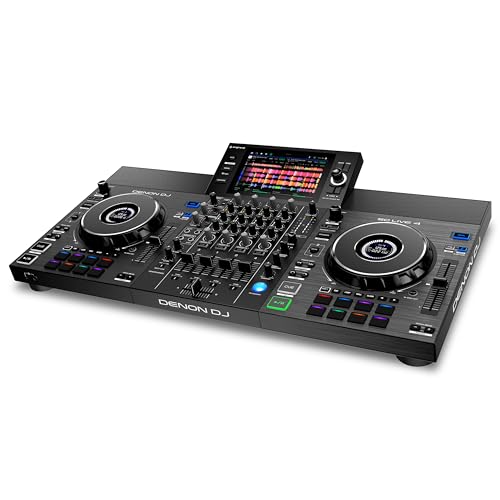
Premium Standalone Pick – Denon DJ SC LIVE 4
The Denon DJ SC LIVE 4 is a powerful dj mixer and four-deck controller for performers who want to work without a laptop. Its Engine DJ OS, touchscreen, wireless streaming, built-in speakers, and broad connectivity make it suitable for practice, mobile gigs, and club-style setups.
Best For: Mobile, streaming, and club DJs who want standalone performance capability.
Pros:
- Supports laptop-free performances through Engine DJ OS, an SD slot, and two USB inputs.
- Four-deck control, stem separation, touchscreen browsing, and Serato DJ compatibility offer substantial performance flexibility.
- Built-in speakers, Bluetooth audio, Wi-Fi streaming, microphone inputs, and XLR main output support varied setups.
Cons:
- Its larger 28.3-inch width and 13.6-pound weight make it less portable than compact controllers.
- The feature-rich design may be more equipment than beginners need.
The SC LIVE 4 stands out when standalone operation and connectivity matter more than a minimal footprint. It is a strong choice for DJs who want an all-in-one booth that can adapt from home practice to live performance.
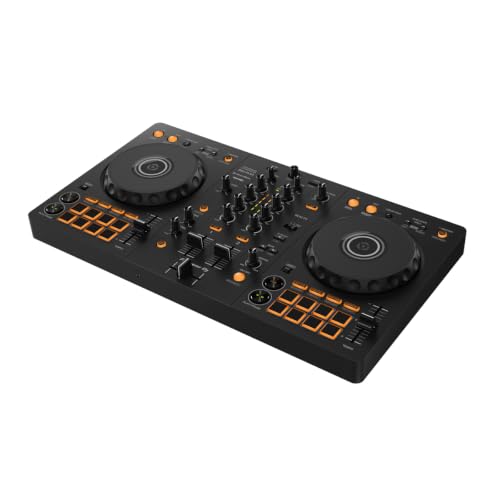
Best Learning Controller – Pioneer DJ DDJ-FLX4
The Pioneer DJ DDJ-FLX4 is a beginner-friendly two-channel dj mixer and controller designed to make early mixes approachable while leaving room to develop. Its familiar layout, Smart Fader, performance pads, and compatibility with multiple platforms make it a versatile starting point.
Best For: New DJs who want simple controls, streaming support, and a path toward more advanced mixing.
Pros:
- Smart Fader automatically adjusts volume, bass, and BPM to simplify transitions.
- Sixteen performance pads support hot cues, Pad FX, beat jumps, and samples.
- Works with PC, Mac, iPhone, iPad, and Android, with USB and Bluetooth connectivity.
- Supports music services including Apple Music, Tidal, and Beatport, plus livestreaming and MC use.
Cons:
- Two-channel, two-deck control provides less mixing capacity than four-channel controllers.
- Some features depend on compatible software or connected devices.
The DDJ-FLX4 balances accessibility with useful growth features. Its compact 2.8-kilogram design and cross-platform support make it a practical dj mixer for learning at home, streaming, or taking to casual sessions.
Best Party Starter – Numark Party Mix III
The Numark Party Mix III is a compact dj mixer for first-time and casual DJs who want an easy way to create party-ready mixes. It combines two-deck controls with built-in beat-synchronized lights, beginner guidance, Bluetooth MIDI, and USB-powered portability.
Best For: Casual DJs, parties, and beginners who want visual effects and simple mobile or laptop mixing.
Pros:
- Built-in LED lights create beat-synchronized patterns for an instant party atmosphere.
- Beat Align indicators and automatic Fade FX help beginners learn timing and transitions.
- Eight performance pads per deck, stems controls, jog wheels, EQ, filters, and a crossfader provide hands-on control.
- USB-C, Bluetooth MIDI, included software, and USB power support flexible portable use.
Cons:
- Its two-deck design is aimed at casual and beginner use rather than larger professional setups.
- The main audio output is RCA, which may require an adapter for some speaker systems.
The Party Mix III focuses on immediate fun without removing useful mixing fundamentals. Its small 2.42-pound chassis, built-in lights, and included software make it an appealing dj mixer for home parties and beginners practicing with a laptop or mobile device.
Best Beginner DJ Controller – Pioneer DJ DDJ-FLX2
The AlphaTheta Pioneer DJ DDJ-FLX2 is a compact dj mixer-style controller for new DJs who want to learn quickly. Its Smart Fader can automatically match volume, BPM, and bass while you move between tracks, and USB-C bus power makes it easy to use with a phone, tablet, or computer.
Best For: First-time DJs who want portable hardware, guided mixing features, and support for streaming services through compatible apps.
Pros:
- Smart Fader helps automate key beatmatching adjustments.
- Lightweight 2.7-pound design runs from USB-C bus power.
- Works with rekordbox, djay, and Serato DJ Lite on supported platforms.
- Supports headphone cueing and speakers through the 3.5 mm output.
Cons:
- Designed as a beginner-focused two-channel controller.
- Streaming access depends on compatible apps and services.
The DDJ-FLX2 is a practical starting point if convenience matters more than advanced standalone controls. Its small footprint, included DJ course, and automated mixing assistance can shorten the learning curve.
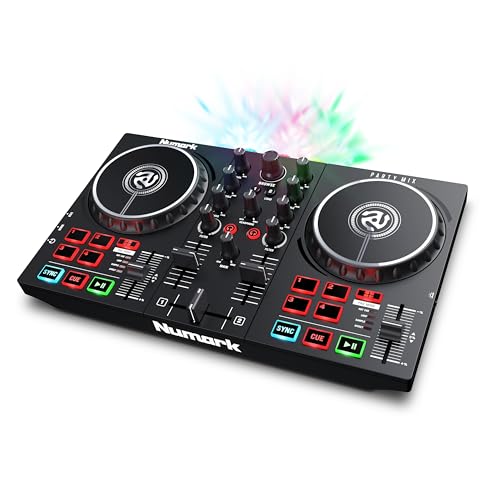
Best DJ Controller With Lights – Numark Party Mix II
The Numark Party Mix II is an approachable dj mixer and Serato DJ Lite system with two decks, an integrated audio interface, and built-in party lighting. It offers the essential controls beginners need, including jog wheels, performance pads, EQ controls, pitch sliders, and a crossfader.
Best For: Beginners who want a plug-and-play controller with visual lighting effects for casual parties and home practice.
Pros:
- Built-in LED lights sync with the DJ mix.
- Includes two touch-sensitive jog wheels and performance pads.
- Integrated mixer provides 2-band EQ, channel faders, and crossfader.
- Offers headphone and 1/8-inch main outputs.
Cons:
- Uses a compact plastic construction.
- Designed primarily for Serato DJ Lite and Mac or Windows use.
- USB Type-B connectivity may be less convenient than USB-C.
The Party Mix II prioritizes fun and simplicity over extensive professional features. Its built-in light show makes it especially appealing for informal gatherings, while the familiar two-deck layout provides a straightforward way to practice mixing.
Best Guided DJ Mixer – Hercules DJControl Inpulse 200 MK3
The Hercules DJControl Inpulse 200 MK3 is a compact two-channel dj mixer-style controller built around beginner guidance and portable performance. Beatmatch Guide LEDs, step-by-step DJ Academy tutorials, and Intelligent Music Assistant features help new users align tracks and choose compatible music.
Best For: New DJs who want guided practice, streaming access, and a lightweight controller for home use or small events.
Pros:
- Includes professional software and step-by-step tutorials.
- Beatmatch Guide LEDs assist with track alignment.
- Supports stem separation for isolating vocals and instrumentals.
- Streams from services including Spotify, Apple Music, TIDAL, and SoundCloud GO+.
Cons:
- Compact two-channel design may be limiting for advanced setups.
- Streaming and software features depend on supported services and platforms.
The Inpulse 200 MK3 is a strong learning-oriented option for users who want more guidance than a basic controller provides. Its 2.2-pound body and USB setup also make it convenient to carry between practice spaces and casual gigs.
How We Picked the Best Dj Mixer Options
We selected these Dj Mixer options based on the features that matter most in real-world use: channel count, software compatibility, standalone capability, portability, performance controls, connectivity, build quality, and ease of learning. The list includes compact two-deck controllers for beginners, feature-rich four-channel units for advanced mixing, and standalone systems for DJs who want to perform without a computer.
We also considered whether each model suits a specific use case, including home practice, parties, mobile gigs, club-style mixing, and live transitions. Because “Dj Mixer” often refers to both traditional mixers and controller-style systems, this guide focuses on integrated DJ hardware that combines mixing controls with playback and performance features.
Quick Comparison
| Best For | What to Look For |
|---|---|
| Beginners | Two decks, simple software, guided learning tools, and clear controls |
| Mobile DJs | Compact construction, built-in audio output, flexible connectivity, and reliable portability |
| Advanced performers | Four channels, track separation, effects, performance pads, and club-style layouts |
| Laptop-free setups | Standalone playback, onboard screens, storage support, and independent operation |
| Parties and casual use | Built-in lighting, Bluetooth support, quick setup, and an accessible price |
Key Dj Mixer Buying Factors
Decks and Channel Count
A two-channel Dj Mixer is sufficient for learning beatmatching, practicing transitions, and most home or small-party sets. Four-channel models provide more room for layered mixes, multiple sources, live instruments, or gradual upgrades.
Software and Standalone Operation
Check whether the controller works with your preferred platform, such as Serato DJ or rekordbox-compatible software. Standalone systems can play tracks directly from supported storage or internal software, which is useful when you want a cleaner, laptop-free setup.
Performance Controls
Look for jog wheels, hot cues, looping controls, effects, pads, and dedicated track-separation features if creative live remixing is important. Beginners may benefit more from intuitive layouts and learning tools than from a large number of advanced functions.
Connectivity and Portability
Review the available master outputs, headphone connections, microphone inputs, USB ports, and wireless features. Compact controllers are easier to transport, while larger systems generally provide more hands-on control and stronger expansion potential.
Who Should Buy Which Dj Mixer?
Choose a compact two-deck controller if you are learning to DJ, practicing at home, or want an affordable setup for occasional parties. Models with beginner software support and guided performance features can shorten the learning curve.
Mobile DJs should prioritize portability, dependable outputs, microphone support, and fast setup. A standalone system is especially appealing if you want to avoid carrying a laptop or reduce the number of devices used at events.
Experienced DJs and performers should consider a four-channel controller or advanced all-in-one system with broader effects, track-separation tools, detailed displays, and room for more complex mixes. For casual parties, built-in lights and Bluetooth can be more valuable than professional expansion features.